Showing posts with label Agriculture. Show all posts

Wednesday, November 4, 2015

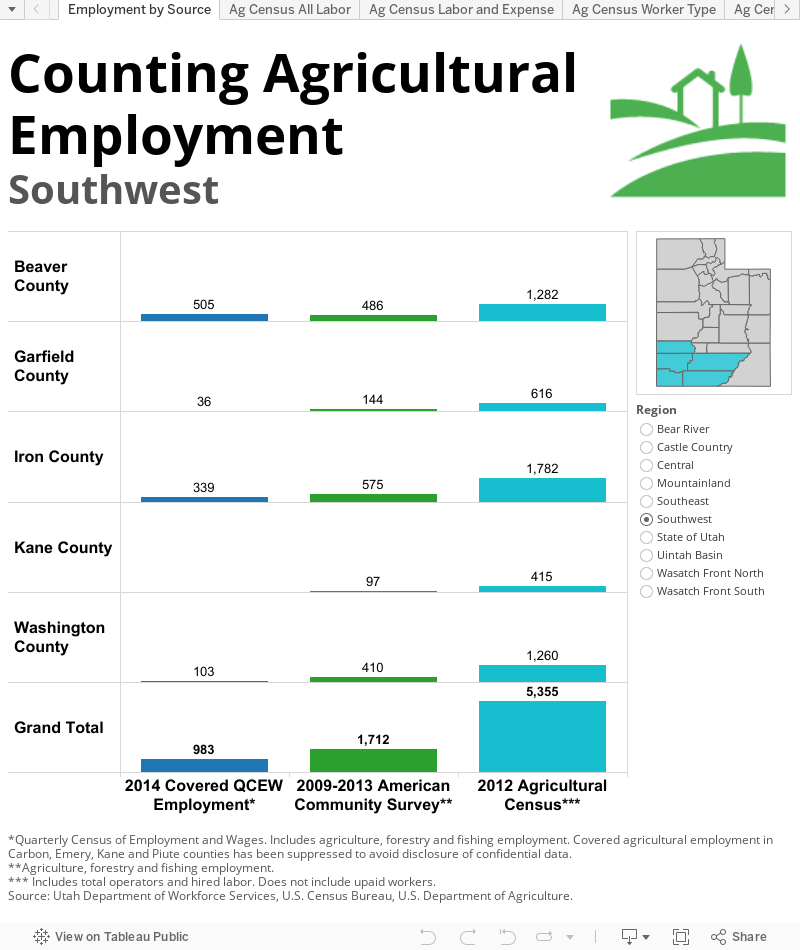
Agricultural Employment – The Census of Agriculture Gives a More Complete Picture

By Matt Schroeder, Regional Economist

Farming, (or more generally, agriculture) is obviously an important part of the economy, so why is that when you hear employment statistics reported in the news, you typically hear them reported as “nonfarm” employment?

“Nonfarm payroll employment” is terminology from the Bureau of Labor Statistics’ Quarterly Census of Employment and Wages (QCEW), and the term is slightly misleading. There is, in fact, some data on agricultural employment in the QCEW data typically reported, it’s just not complete. QCEW employment data is based on administrative records from employers who pay into the state’s Unemployment Insurance (UI) program, so workers not covered under UI laws are not captured. Agricultural employers are generally exempt from the requirements for UI coverage, so the data are simply not comprehensive enough to calculate reliable estimates. Furthermore, many agricultural operations are sole-proprietorships that are also exempt from UI coverage (whether in agriculture or not), so those individuals are not recorded either.

All of this comes down to the fact that the typical “nonfarm” employment statistics you hear about in the news, on average, do not include roughly 90 percent of Utah’s agricultural employment. In 2012, QCEW reported fewer than 5,000 employees in “Covered Agriculture” for the whole state, which represented less than one half of one percent of Utah’s total employment.

Fortunately, the Census of Agriculture, conducted by the U.S. Department of Agriculture once every five years, gives a revealing picture of the agricultural sector. The most recent data, covering 2012, were released last May 2015. The Agricultural Census surveys all of those UI-exempt farms that the QCEW misses and found that there were nearly 47,000 jobs in agriculture in 2012 — more than 3.5 percent of Utah’s total employment.

The share is not quite as large in the Wasatch Front North region, where agriculture represents about 2.6 percent of the local economy — according to the Census of Agriculture. But this is a much larger share than the 0.4 percent suggested by the QCEW. Weber and Davis counties respectively rank 4th and 9th in the state in terms of total agricultural employment. Morgan County is relatively small in total number, but agriculture’s share of all Morgan County jobs is more than 30 percent.

Agricultural Profile of Wasatch Front North


By Matt Schroeder, Regional Economist

The visualization above uses data from the 2012 Census of Agriculture to profile the agricultural activity of the Wasatch Front North region. You can adjust the filter to view individual counties or groups of counties as well as change the year to 2007 to see how things changed since the last Census of Agriculture. To view the profile of the whole state, select “Statewide” alone.

As a whole, the Wasatch Front North region had more than 1,900 farms in 2012 representing about 11 percent of the state’s farms but only about 4 percent of the state’s total farm acreage — highlighting the relatively small average farm size in the region. The bar chart in the center suggests that of those farms, more than 1,400, or about 77 percent, were very small farms with less than 50 acres.

Despite the small farm sizes, as the title above the map at the right shows, roughly 42 percent, or 400,000 acres, of Wasatch Front North’s 950,000 acres of land are used for agriculture. The pie chart at the bottom-left displays that about 310,000 acres of that are pasture and rangeland while only about 62,000 acres are cropland. Two-thirds, or about 200,000 acres, of the region’s pasture and rangeland is in Morgan County.

In terms of value, the Wasatch Front North’s agricultural sales comprised more than 5 percent of the statewide total in 2012. The second pie chart, at the bottom-right, shows that of the roughly $100 million in agricultural sales in 2012, more than half was from the sale of crops. More than $22 million in nursery, greenhouse, floriculture, and sod sales comprised the largest proportion of that. Of the livestock products sold, the largest category, in terms of value, was milk, at nearly $17 million, or 17 percent of the total.

Monday, May 6, 2013

Utah farmers facing another irrigation water shortage

The Weber Basin Water Conservancy District is already warning Utah residents that they’ll need to conserve water this summer.

Utah is expected to have another hot and dry summer. The month of May just began and hydrologists are already talking about a drought for the second year in a row.

While Utah suffered a drought last year, what’s different this year is that many reservoirs aren’t as full. The seven reservoirs in the Weber Basin’s District are only 50 to 70 percent full. Fox13

Friday, January 18, 2013

Bountiful Fresh Market to close

The Fresh Market store in Bountiful will close in February and a nearby Dick’s Market will be remodeled in an attempt to attract more shoppers, owner Associated Food Stores said.

Associated will remodel the Dick’s Market at 2280 S. Orchard Drive immediately. It will stay open during the remodel, which should be finished in the spring. The Fresh Market store at 535 S. 200 West will close Feb. 9.

"We will be able to combine the best elements from Fresh Market with the exemplary offerings of Dick’s Market," Troy Thomas, vice president of Associated Retail Operations, said in a statement. "The combination of Fresh Market and our remodel at Dick’s Market will make our grocery store one of the finest in Davis County."

Most Fresh Market and Dick’s Market employees will keep their jobs, but there may be some reduction as a result of the consolidation, the company said. It estimated that as many as five workers may be laid off.

In March, Associated closed a Fresh Market supermarket in West Valley City. Salt Lake Tribune

Wednesday, December 12, 2012

Utah Manufacturing Goes into Orbit

One of the World Leaders and best known irrigation product manufacturing companies has decided to expand in Utah again. Orbit Irrigation Products, Inc., along with the Governor’s Office of Economic Development (GOED) announced today that it will move 60 jobs from Asia to their North Salt Lake headquarters manufacturing location. To support the growth of their company, Orbit will invest nearly $37 million in capital investment over a 15 year period.

These 60 new incented positions will pay a minimum of 125 percent of Davis County’s average yearly wage including benefits. Wages over the lifetime of the agreement will total more than $68 million. In addition, Orbit will pay approximately $22.2 million in new state taxes over 10 years.

“Orbit is a family company with deep roots in Northern Utah.We are optimistic about our future growth and equally as thrilled to be able to bring jobs back to our community.” Orbit CEO, KC Ericksen, said.

Founded in Davis County over 40 years ago, Orbit distributes their 2,000 products to more than 40 countries in five continents. Most of Orbit’s design, manufacturing, production and warehousing occur at their North Salt Lake headquarters as well.

Utah’s manufacturing sector is the third largest employment sector in Utah, comprising about 9.6 percent of Utah’s workers, totaling more than 114,700 people. Workers in this sector also receive wages that are 22 percent higher than the average monthly wage in Utah. Utah Pulse

Monday, July 16, 2012

Utah Farm Bureau Hosts Midyear Conference

The Utah Farm Bureau Federation (UFBF) will be holding its annual Midyear Conference July 19-20 at the Ogden Eccles Conference Center in Ogden. The theme for this year’s conference – Building Bridges to a Brighter Future – illustrates the priority of Utah’s farmers and ranchers to bridge the gap between rural and urban understanding of what it takes to grow food as well as what consumers today are expecting from farmers and ranchers.

The conference will include several presentations on issues concerning farmers and ranchers as well as urban Utahns. Dennis Strong, Director of Utah’s Division of Water Resources, will present on the realities of developing water in Utah and what the future holds for funding water projects. Strong will be followed by Linda Hull, Policy and Legislative Services Director of Utah’s Department of Transportation, who will present on the funding of rural and urban transportation needs. Hull will discuss the realities of Utah transportation planning, including on-going projects and future concerns.

Attendees will learn about local market opportunities for the food they produce from a diverse panel of food users. Presenters will include Zeke Wray, executive chef of Talisker Restaurant; Jed Christenson, marketing director of Utah’s Own; Jana Cruz, Director of Nutrition Services for Jordan School District; and Barry Houghtalen, Vice President of Purchasing for Nicolas & Company.

Additional topics to be presented at the conference will include how to make an impact using social media for a little as 15 minutes per day. Paul Hill from the USU Extension will speak on the benefits and the process of using social media as a rancher or farmer.

The midyear conference creates a central gathering point for farmers and ranchers from across the state, where people from a variety of farming and ranching backgrounds can meet and discuss those issues that impact their livelihood on a daily basis. It also serves as a means for educating farm and ranch leaders on current issues impacting agriculture and on developing policy solutions that meet those needs. The Main
Street Journal

Monday, April 16, 2012

Multigenerational dairy business suffers in West Weber

Ron Gibson grew up to become a fifth-generation dairy farmer, and he’s raising the sixth generation now. He’ll be raising and milking his cows with his sons as long as he can — but the way the industry has been going, it has been a stressful and uncertain time for him and many others

The cost of keeping the operation going keeps growing, but the market-determined price of the milk hasn’t. “It doesn’t matter how well I take care of my cows … if I put in (a full day’s work) or two hours of work,” he said, watching his son check on the pregnant cows at his West Weber farm.

The recession didn’t help, said Randy Parker, CEO of the Utah Farm Bureau Federation. The value of the dollar dropped, making American dairy products much more expensive in global markets, he said.

Parker said every Utah dairy farm is family-owned, and some employ several generations of families. How to save the dairy farmers “is the million-dollar, or billion-dollar, question,” he said.

“The reality is, it’s very difficult right now, and there’s just not a good answer locally or nationally in terms of policy that can answer these difficult questions,” Parker said. However, he added, it does help that Congress is taking a look at the 80-year-old legislation governing the milk market to determine if it’s still adequately meeting the farmers’ needs. Standard Examiner

Monday, June 20, 2011

Floods put Weber County farmers in fix

Western Weber County has been called the epicenter of flooding in the state, and farmers and ranchers say they've been in the worst holding pattern of their lives since April. Regardless of any issues with levees and river control, ground water here just won't go away and it will keep many farmers from even beginning to work their ground, likely for another month. At present, no one knows for sure what the exact dollar impact will be. There's no accounting of how many total acres now are underwater. Ogden Standard-Examiner