Showing posts with label Careers/Education. Show all posts

Wednesday, January 27, 2016

How educated is the Wasatch Front North’s workforce?
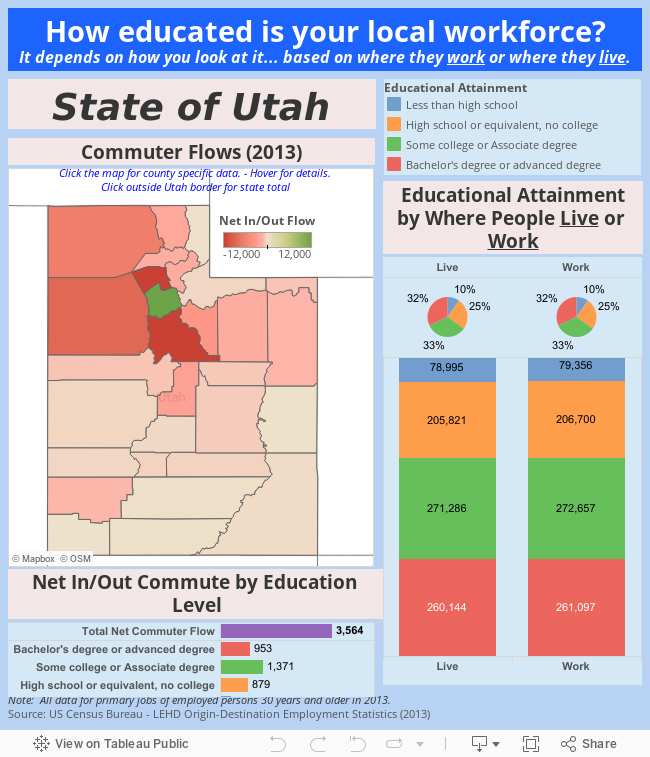
It depends on how you look at it — based on where they work or where they live.

Matt Schroeder, Regional Economist

Local leaders have become increasingly aware of the relationship between the education level of their local workforce and the economic strength of their communities. Higher levels of education are closely linked to higher incomes for individuals; which, in turn, brings in higher tax revenues and lower government social program costs. People with higher education levels tend to be healthier, more involved in community organizations and give more to charity. They are also less likely to be chronically unemployed, less likely to require social assistance, and have lower incarceration rates.

More broadly, when businesses look to expand or locate in a particular area, one of the primary factors they consider is the availability and training of the local workforce. A region with a more highly educated labor pool will tend to draw businesses that need highly educated employees. Those jobs, in turn, tend to garner higher wages. Higher wages mean more consumer spending and tax revenue for local governments, which allow for investment in infrastructure, public services and community development.

These benefits have long been known and I mention them to highlight why so much emphasis is often placed on education in the public arena. It really matters for community health and development. But there is an interesting question to this issue that is seldom explored when we think about how to better educate our local workforce: Should we be focusing on the education levels of the people who live in our communities, or on those who work in our communities?
To clarify, we’re talking about community investment in increasing higher education attainment levels, not the funding of primary and secondary education. On the resident workforce side, this may include expanding post-secondary degree programs and institutions, or encouraging and supporting student enrollment in higher education. On the working workforce side, higher levels of educational attainment are achieved by growing the number of jobs that require higher levels of education. Community investments to achieve this may include developing infrastructure and facilities to meet the needs of businesses, incentives for target industries.

For a local city or county considering investing in these types of development projects with limited funds, where should their focus be? This is an especially relevant question in an area like the Wasatch Front North where the local commuting patterns are very fluid. Thousands of commuters flow (mostly south) along I-15 every day to jobs in other cities and counties. A well-educated economist, for example, may be living in Ogden, but commutes down to Salt Lake City every day for work. Should local leaders be concerned with developing a better-educated resident workforce if they are likely to commute somewhere else for work? Or should the community be more focused on bringing in the kinds of jobs that will help keep an already well-educated population working closer to home?

The answers to these questions depend on the specific characteristics of local economies, and unfortunately, no single answer or formula can be applied across the board. As a start, it helps to first have a picture of what’s actually happening. The interactive data visualization above allows you to see the situation for your county. Click on the map to see your county and hover over each chart to see details and an interpretation of the data.

In Davis, Morgan and Weber counties more people commute out for work than come in. Of the three, Davis County has the largest net outflow, with more than 26,000 net out-commuters representing about 30 percent of the resident workforce. Of those 26,000, more than 40 percent, or some 11,000 net out-commuters, have a bachelor’s degree or higher. The share of workers with a bachelor’s degree living in Davis County is 34 percent while the share working there is just 31 percent.

Morgan County sees the largest percentage of its resident workforce commute outside the county for work. The net out-flow of 1,800 workers represents more than 60 percent of the resident workforce and about 650 of those have a bachelor’s degree or higher. The share of workers with a bachelor’s degree or more living in Morgan County is 33 percent — 6 percentage-points higher than the 27 percent with the same level of education actually working in the county.

Weber County has the lowest rate of worker out-flow of the three counties. More people commute out for work than come in, but the net outflow of about 1,600 represents only 2.5 percent of the resident workforce, and about half of those are workers with a bachelor’s or higher.

Each of these counties is distinct in terms of the factors that play into why their worker flow patterns exist. For Davis and Morgan counties there is clearly a current resident population more educated than the local job market demands. It may be worth exploring the possibility that those areas may benefit from a greater focus on high-skilled job creation. Weber County, on the other hand, is currently balanced in terms of the share of highly educated workers that live and work there, but with a relatively low share in both, Weber may benefit most from a two-pronged approach that seeks to bring in higher skilled jobs while at the same time building the workforce to fill them.

Thursday, September 4, 2014

Long-Term Employment Projections

The long-term employment projections have been updated for the time period of 2012 to 2022. Projections are produced for the state of Utah as well as for eight sub-state areas. The areas are determined by population and job density and are not created equal. But rather, types of jobs are determined by the nature of the local area’s economy. Short-term projections for 2012 to 2014 are also provided for statewide.

The value in providing these projections is to help identify which types of jobs are most likely to be in high demand in the future. Ultimately, the long-term employment projections act as a forecasting measure by which individuals as well as organizations and agencies can plan ahead.

See the latest long-term projections produced by DWS for the Ogden/Clearfield MSA area.

Friday, August 29, 2014

A Story of Wage Data

The Wages and Income page has a new look to the wage data that is gathered by the Workforce Research and Analysis division. Along with visualization of the data, you can now read story points at the top of each graph, to help understand what the data is showing you along with highlighting its insights. Just click along the story points at the top of the visualization to follow the story of wages.


Thursday, February 13, 2014

The Value of Education in the Wasatch Front North

Tyson Smith, Economist


Although college tuition has increased at an meteoric pace over the last 50 years, the value of obtaining a college degree still outweighs the costs according to a new study from the Pew Research Center. In fact, the study argues that “On virtually every measure of economic well-being and career attainment—from personal earnings to job satisfaction to the share employed full time—young college graduates are outperforming their peers with less education.” Not only are young graduates economically better-off than their peers, but the disparity in financial well-being is greater for this generation than any other generation in modern history.

Click on Chart to Enlarge Image
You may be wondering, “What is the effect of educational attainment on people that work in my county?” While we don’t have access to the same data at the county-level that the Pew Research article uses, there are proxies that can illuminate the value of education in the Wasatch Front North. The U.S. Census Bureau publishes the American Community Survey (ACS), which includes five-year population estimates for areas as small as census tracts and block groups. The ACS collects data on employment, education, and income. We can use ACS data to estimate the economic impact of higher education for each county in the state.

The Wasatch Front North counties follow the same pattern as the national trend. College graduates earn significantly higher wages than high school graduates. Furthermore, the proportion of college graduates living in poverty is much lower than the percent of high school graduates or less.

The ever-increasing costs of pursuing higher education, and the perilous consequences of astronomical student debt, have been well documented. However, it appears that the benefits of graduating from college continue to outweigh the costs.

Note: For more analysis of the favorable influence of educational attainment in the State of Utah, click here.

Friday, March 1, 2013

Ogden, Provo and Salt Lake City named top cities for career and family

An interactive map from Improvement Center rates the best cities to live in for 35 different categories. Some of the categories include: best holiday spirit, best for couples, best for women, low-stress, best for young professionals, most-caffeinated, most tax friendly and highest paying jobs.

Improvement Center lists Ogden at No. 5 in the category of highest median income.

Other Utah cities placed in the categories of best place to raise a family and best for business and careers. On the family list, Provo is third and Ogden is eighth. For best careers, Provo is first and Ogden sixth. Salt Lake City is also the fourth-best city for young professionals.

To view the map, visit ImprovementCenter.com

Deseret News

Tuesday, February 12, 2013

Startup weekend NEXT program comes to Utah

Now is the time to learn proven techniques to grow your business. Startup Weekend NEXT is an intensive, in-person, mentor-driven course meant to assist startups in the beginning stages of development.

The Utah Science Technology and Research initiative (USTAR) along with Startup Ogden is pleased to partner with Startup Weekend to bring this exciting program to Davis County. Startup Weekend NEXT lean startup training program is a five-week program focused on customer discovery methodology developed by Silicon Valley entrepreneur, Steve Blank.

Startup Weekend NEXT will be held each Wednesday evening starting March 13 through April 10, at the Northfront Business Resource Center at the Davis Applied Technology College in Kaysville, UT. The cost is $250 a person with team discounts available. The registration fee also includes dinner and registration is capped at 10 companies. Utah Policy

Wednesday, February 6, 2013

As Utah students struggle, businesses enter the classroom

A business in Morgan has become one of the first to join a statewide movement to get involved in Utah schools.

Employees of Holcim Cement gather at Morgan Elementary twice a week to be Read Today tutors, an unlikely group to be sitting at the desks of little kids.

"When we are working with these kids, big smiles on our faces, it's a really nice break out of the day," said plant manager Keith Krugh. "It does I think as much good for us as for them."

It's not just corporate responsibility that drew Holcim Cement to be Read Today tutors, though. Twice a week, they send employees to the school knowing they're making a difference in their own neighborhood.

"To have professionals come in and make a connection with the kids benefits the reading, and the comprehension is amazing," said Tim Wolff, principal of Morgan Elementary. "The benefits and connection to the community are great, too."

The Holcim employees have become a model for what groups like Read Today and Prosperity 2020 hope will become a grassroots effort, with businesses helping schools.

"It's a wonderful example of a partnership between private industry, government and, you know, the school, KSL —just being partners together, making something wonderful happen," said Ben Johnson, CFO of United Way of Northern Utah.

Utah ranks 29th among states in public education spending per $1,000 of personal income, and spends less per pupil than any other state.

Although eighth-grade students in the state score above the national average on standardized math and reading tests, they score last among states with similar incomes, parents' educations and ethnic diversity. KSL

Wednesday, January 16, 2013

Fuel Your School Program Benefits Nearly 700,000 Students in Nine Communities across the U.S.

Chevron U.S.A. Inc. and DonorsChoose.org today announced that its Fuel Your School program funded $4.49 million, benefiting local classroom projects at 1,733 K-12 public schools across the country and impacting a total of 697,904 students in 2012.

Through Chevron's Fuel Your School program, 5,673 teachers in nine markets received critical classroom resources.

Through the Fuel Your School program, Chevron contributed $1 for purchases of eight or more gallons, up to a total contribution of nearly $5 million, between Oct. 1 and Oct. 31 at participating Chevron and Texaco stations in nine U.S. markets, including Salt Lake and Davis counties. In total, $4.49 million dollars were generated to benefit [nationwide] public school classroom projects posted on DonorsChoose.org.

The purpose of the Fuel Your School program is to help support and improve critical education programming and materials, particularly in the STEM subjects - science, technology, engineering and math - to help prepare students for the growing number of technical jobs in the modern economy, including possible engineering positions at Chevron. Market Watch

Thursday, December 13, 2012

Solving Utah's Dismal Graduation Rate

Utah is the fourth-worst state in the nation for graduating Latino students, with just 57 percent of seniors collecting a diploma each year.

The sobering numbers, better than only Minnesota, Nevada and Washington, D.C., and first reported last week, were called disappointing and unacceptable by Gov. Gary Herbert as he cited poverty levels and language barriers as contributors to the low performance.

But at least two programs both inside and outside the state of Utah could provide a template for how to increase the number of high school graduates, particularly in the minority communities that lag far behind other states.

The schools have successfully increased graduation rates and student performance by offering incentives for good attendance, requiring extended class time for struggling students and using in-depth analysis of assessment data to track and target individual at-risk children.

In many cases, these programs are coupled with sweeping administrative and faculty changes that officials say help create a new atmosphere of learning, and it's done without a large outlay of new money.

Minority graduation rates in Utah have steadily increased each year, but the state continues to lag behind the nation and public schools are expected to become more diverse. Utah's 137,647 minority students account for 23 percent of the state's public education population, according to the Utah State Office of Education, and are growing at more than double the rate of the state as a whole.

Schools around the country have tried various methods of targeting their at-risk student populations and while progress has been slow, gains have been made. Richard Fry, a senior researcher with the Pew Hispanic Center, said that more than three-fourths of Hispanic adults ages 18 to 24 have a high school diploma or GED, a benchmark reached last year.

In Ogden School District, one of the most diverse and historically low-performing school districts in the state, a focus on improved attendance and the use of individual student data-tracking, as well as district-wide administrative shakeups, has resulted in marked improvements in student proficiency and graduation rates.
Between the 2010-11 and 2011-12 academic years, the graduation rate at Ben Lomond High School increased from 78 percent to 81 percent. Ben Lomond's sister school, Ogden High School, saw even greater gains, jumping 11 percentage points from 77 percent to 88 percent.

The reason: They are focusing on getting kids to class, including providing incentives for keeping them there.
Both schools graduate roughly 98 percent of their senior students who attend class. Both schools are also evenly split between white and Hispanic students and a majority of students qualify for free or reduced lunch.
Maureen Kopecky, Ogden High head counselor said in the past there was little consequence for a student arriving late, or not at all, to class. Now, she said, students have responded to the incentives —and some punitive measures — and in the process have figured out that it's easier to pass their classes when they actually attend.

The schools also rely heavily on student tracking data, part of a district-wide effort that has seen the halls and classrooms of Ogden School District decorated with graphs and tables tracking performance and attendance.

It's a common problem, as grade configurations often mean students begin falling off track in junior high. After the success of their senior Hot Lists, Ogden School District asked junior high schools to make freshman lists as well, and counselors from feeder and upper level schools work together to get students back on track and to stop them from falling off in the first place.

John Jesse, director of assessment and accountability for the State Office of Education, said the transition from middle to high school is a critical time when students begin slipping through the cracks. He said many junior high schools in the state use summer programs to make up lost credits, but some of the most successful programs give extra class time or restrict a student's ability to take elective courses during the school year until they pass required coursework.

Lakeridge principal Garrick Peterson said for the most part, the school has been able to implement the changes with little additional costs. Flex time, for example, required only the reallocation of time and resources. He estimated that the costs associated with the data analysis, which required an additional secretary, as well as summer hours and conferencing to train teachers add up to an annual cost of $20,000, which is absorbed as a priority of the school's fund from trust land money.

Similarly at Ogden High School, Briggs said the school has been able to handle the extended lunch periods, data analysis and home visits with existing staff and resources. Two part-time attendance trackers were brought on to help get students to class, for a combined total of $25,000, which is paid for through a federal school improvement grant.

While there are certain practices and procedures educators can point to as catalysts for improvement, Kopecky said there are a number of indefinable factors, like the commitment and attitude of teachers and parents that contribute to a school's success.

Geihs spoke of the importance of involving students in the dialogue of school and performance improvement. He said that to be successful, educators need to be clinical, like physicians, as well as ministerial, like reverends.

"You can't do anything to help a student progress without positive relationships," he said. "Everybody needs to understand where they were and where they need to go academically." Deseret News

Tuesday, October 23, 2012

Job Workshops for Women to Begin

People Helping People Weber/Davis is starting its next round of workshops to help women advance in the workplace.

The next program overview will be from 6:30 p.m. to 8 p.m. Wednesday at Cottages of Hope, 2724 Washington Blvd.

The overview will explain the employment program and how it can help clients get a job or a better job, keep a job or move up in the job. The purpose is to help participants learn to earn a living wage. Standard Examiner

Thursday, September 6, 2012

Five Utah School Districts to Apply for Millions in Federal Cash

At least five Utah school districts plan to vie for millions in federal cash as part of the U.S. Department of Education’s Race to the Top District program.

The Granite, Ogden and Provo school districts plan to seek $20 million to $30 million each; the Morgan County School District will likely apply for $5 million to $10 million; and the Washington County School District plans to apply for $30 million to $40 million, according to the U.S. Department of Education.

The five districts are among 893 nationwide that have submitted letters saying they intend to apply for a chunk of nearly $400 million meant to support reforms aimed at personalizing learning, closing achievement gaps and preparing kids for college and careers.

The department has previously held Race to the Top competitions for states as well. Utah, as a state, applied for a $175 million Race to the Top grant in 2010 but did not win one. Salt Lake Tribune

Tuesday, September 4, 2012

Construction on Utah university campuses marks growth

Construction projects at universities across the state point to a steady stream of students staying on campus in addition to schools increasing online options.

Every four-year school in Utah has construction under way, from full-scale building expansion at the University of Utah to projects as small as a ramp connecting the upper and lower campus at Southern Utah University to create wheelchair access.

While enrollment numbers are still in flux, representatives from the University of Utah estimate an increase of more than 600 students on campus this semester, as compared to 2011. University officials reported 31,950 students enrolled last year, and had 32,592 enrolled in this first week of the semester.

Weber State University, traditionally a commuter campus, is increasing options for a traditional college atmosphere. The open-admissions school is in the home stretch of its three-building campus housing project. Stewart Wasatch Hall, the second building in the Wildcat Village project, is filled to capacity for its inaugural semester. Ground has been broken for the final building.

Officials at Utah State University are anticipating their enrollment numbers to be even with last year, keeping on par with a 10-year growth trend. Trent Hunsaker, USU marketing director, said students are still seeking out a traditional on-campus experience.

In Southern Utah, Dixie State College is preparing to dedicate its Jeffrey R. Holland Centennial Commons on Sept. 7. The school received $35 million from the Utah Legislature in 2010 for the building's construction, on top of $3 million in 2009 legislative funding that went into planning, according to a Dixie news release. The six-story building houses a library, the English department, classrooms and student services including registration and financial aid. It is part of the school's plan to manage ongoing growth. Deseret News

Wednesday, August 15, 2012

Stewart Wasatch Hall Opens at Wildcat Village

Wildcat Village, a 172,150-square-foot student-housing project at Weber State University, opened Stewart Wasatch Hall, the second of three buildings, Tuesday afternoon.

Replacing Promontory Tower, LaSal, Wasatch and Stansbury halls in Wildcat Village will house more than 500 students. The replacement housing halls will each be three stories. Hall 1 is 48,400 square feet, Stewart Wasatch Hall is 88,480 square feet and Hall 3 will be 25,270 square feet.

WSU is building all three halls in the village to be Leadership in Energy and Environmental Design (LEED) Silver Certification candidates. The sustainable effort includes installing solar panels. Utah Business

Wednesday, July 18, 2012

National Center on Shaken Baby Syndrome offers information and help

Many new mothers throughout the world can help with their infants’ crying spells from a group of local residents.

The National Center on Shaken Baby Syndrome provides informational tools at no cost.

When a woman delivers in a hospital or birthing center that participates in the program, she receives a booklet and video to take home. The 10-page booklet is east to read and identifies the period of infants lives when they are most likely to have unexplained crying. The booklet also gives pointers to new parents to help them get through the trauma of the intense crying episodes. Davis Clipper

Monday, July 16, 2012

Utah Farm Bureau Hosts Midyear Conference

The Utah Farm Bureau Federation (UFBF) will be holding its annual Midyear Conference July 19-20 at the Ogden Eccles Conference Center in Ogden. The theme for this year’s conference – Building Bridges to a Brighter Future – illustrates the priority of Utah’s farmers and ranchers to bridge the gap between rural and urban understanding of what it takes to grow food as well as what consumers today are expecting from farmers and ranchers.

The conference will include several presentations on issues concerning farmers and ranchers as well as urban Utahns. Dennis Strong, Director of Utah’s Division of Water Resources, will present on the realities of developing water in Utah and what the future holds for funding water projects. Strong will be followed by Linda Hull, Policy and Legislative Services Director of Utah’s Department of Transportation, who will present on the funding of rural and urban transportation needs. Hull will discuss the realities of Utah transportation planning, including on-going projects and future concerns.

Attendees will learn about local market opportunities for the food they produce from a diverse panel of food users. Presenters will include Zeke Wray, executive chef of Talisker Restaurant; Jed Christenson, marketing director of Utah’s Own; Jana Cruz, Director of Nutrition Services for Jordan School District; and Barry Houghtalen, Vice President of Purchasing for Nicolas & Company.

Additional topics to be presented at the conference will include how to make an impact using social media for a little as 15 minutes per day. Paul Hill from the USU Extension will speak on the benefits and the process of using social media as a rancher or farmer.

The midyear conference creates a central gathering point for farmers and ranchers from across the state, where people from a variety of farming and ranching backgrounds can meet and discuss those issues that impact their livelihood on a daily basis. It also serves as a means for educating farm and ranch leaders on current issues impacting agriculture and on developing policy solutions that meet those needs. The Main
Street Journal

Friday, June 29, 2012

Sallie Mae Bank Awards $90,000 in Utah Scholarships to Future Engineers, Nurses, Respiratory Therapists and Teachers

Sallie Mae, the nation's No. 1 financial services company specializing in education, today announced that its wholly owned subsidiary, Sallie Mae Bank, has awarded a total of $90,000 in scholarships, the largest award amount in its six-year history. The 21 undergraduate recipients are pursing engineering, nursing, respiratory therapy or teaching programs at a higher education institution in six Utah counties.

Since the scholarship program began in 2006, Sallie Mae Bank has awarded nearly $450,000 in scholarship assistance to students attending colleges in Cache, Davis, Salt Lake, Tooele, Utah and Weber counties. Recipients were required to submit a one-page essay detailing their educational goals. MarketWatch

Monday, June 11, 2012

Speaker gives Ogden schools some tips

As community leaders, teachers and administrators from the Ogden School District sat this week in a conference on community schools, a clear vision of the possible future of Ogden schools started to form.

National Community Schools leader Abe Fernandez spoke to the group Wednesday morning and showed how the dream of building a community around a school is starting to become a reality in Ogden School District.

Although many attendees still had questions, some smiled as they thought of how it could really come together.

Fernandez, deputy director for the National Center for Community Schools for the Children’s Aid Society, spoke to school leaders last year as Mount Ogden Junior High was starting its first year of becoming a community school. Standard Examiner

Tuesday, May 22, 2012

Engineers — make way for the women

Many high school senior girls in the Top of Utah are capitalizing on the trend of women moving into the fields of math and sciences, and it has been great for them.

Bonneville senior Elizabeth Radcliffe feels that she was welcomed into Weber School District’s Project Lead the Way Program with open arms. “It was never like, ‘You’re a girl, we don’t want you.’ It was more like, ‘You’re a girl, please come do this,’ ’’ Radcliffe said of her experience with the program.

She said she never thought twice about being a girl in the program; it was more of a confidence issue for her personally. She wasn’t sure if she was smart enough to be an engineer, but after her first classes she quickly came to realize she was. As for being female, she feels it works in her favor.

Because the field is so heavily made up of men, more and more employers want the input a woman can provide, said Roy High School junior Julia Satterthwaite. She has seen the way a woman’s view puts a different spin on the groups she participates in with her engineering classes. Standard Examiner

Monday, April 30, 2012

Students prepare for "Real World" at two-day conference

Four-hundred fifty high school students arrived Friday at Weber State University for a two-day conference on options they may not have realized they have.

Weber State's first Multicultural Youth Conference, "Preparing for the Real World," offered workshops on careers, planning, proper etiquette, self-esteem, scholarship applications, financing college and dealing with racial and gender stereotypes.

Workshops for the registered students, from the Weber, Ogden and Davis School Districts, continue on Friday, with an overall goal of helping students to expect more from themselves, and to plan and work for lives better than they otherwise might have achieved.

Students broke into 11 sessions based on age and interests. The first afternoon session broke students into two sessions based on genders.

Shayla Rivera, an actress and stand-up comic who grew up in Puerto Rico then got a degree in aerospace engineering at Texas A&M, talked to the females about self-esteem, ignoring stereotypes, and making your own opinion of yourself count more than that of naysayers.

In another room in Weber State's Shepherd Union Building, speaker Roderic Land, a University of Utah assistant professor who teaches courses on education and culture and society, addressed the smaller all-male crowd. Land asked his audience for suggestions on the issues they wanted to discuss, leading to a discussion of money, and what students would spend their money on if they had a $35,000 job. Standard Examiner

Monday, April 9, 2012

Economy hides possible impending shortage of nurses

Just like in other professions, the down economy is being blamed for a current abundance of nursing graduates. It’s a stark contrast from five years ago when nursing graduates were getting large bonuses to hire on, said Bridgette Berkeley, and intensive care unit nurse at Ogden Regional Medical Center.

But those close to the situation say the current abundance of nurses is only a temporary problem.

“We are fortunate in Utah, and especially in the Ogden area, to have enough nurses to take care of our population,” said Susan B. Thornock, interim chairwoman of the Weber State University School of Nursing.

“I can say that today, but that cannot be guaranteed for tomorrow or next month or next year.”

Thornock said cutting back on the number of nursing students would be the wrong course of action, locally or nationally.


She said “The Future of Nursing,” a 2010 national report by the Institute of Medicine and The Robert Wood Johnson Foundation, looked closely at how to best supply the country’s need for nurses.

“They encouraged schools and colleges of nursing to not decrease the number of students they presently educate but to increase the level of education,” she said.

Thornock said Weber State has continued to admit the same number of associate degree RNs but increased the number of post-licensure bachelor of nursing students.

Elizabeth Later, chief nursing officer at Ogden Regional, said both the aging population and an aging nursing workforce are matters of concern.

Later said the need for nurses will increase greatly about the time many will be leaving the profession as the baby boomer population ages. Standard Examiner