Showing posts with label Sales. Show all posts

Thursday, July 27, 2017

The New Retail Workforce:
How Online Sales are Changing Retail Jobs in Northern Utah.

Consumer spending makes up around 68 percent of the nation’s gross domestic product. Consumer spending is individuals and families purchasing groceries, clothing, recreation, stocks, insurance, education and much more. The transactions cover a broad swath of economic activity.

Much of the nation’s consumer spending is captured via retail trade. A useful retail trade definition is “the re-sale (sale without transformation) of new and used goods to the general public, for personal or household consumption or utilization.” Not all consumer spending is captured through retail trade transactions, but a large share is.

Broad-category examples of retail trade sectors are motor vehicle sales, furniture stores, electronic stores, building material stores, grocery stores, pharmacies, gas stations, clothing stores and department stores, among others.

Then there is the relatively new and emerging part of the retail trade sphere — nonstore retailers. These are establishments that sell products on the internet. Examples include Amazon, Zappos, Overstock.com, or eBay. These types of retailers have grown rapidly in the past 15 years and their presence is reshaping the retail trade landscape.

Whereas in the past nearly all retail transactions were done through traditional brick-and-mortar stores, now a significant and growing segment is diverted to internet sales. The consumer shops online and FedEx (or like) delivers the product. One can see that the number of brick-and-mortar stores and the level of local sales across the country are being endangered by this economic evolution.

The brick-and-mortar reduction is beginning to show its economic presence in the United States employment numbers. While the U.S. economy is finally expanding at a healthy pace this side of the Great Recession, one of the few industries not rising with this tide is retail trade. While overall retail sales are increasing, employment is not.

Traditionally, as a population increases, retail trade employment grows simultaneously, since population growth and consumer spending volume is an integrated dynamic. If studied deeply, a certain ratio of retail trade employment growth spawned from population growth would emerge. Before the internet, the vast majority of all consumer sales occurred in the immediate community or region. But now, the internet is diverting these sales away from the local community — and with internet sales growing, its market share will increase.

We do not yet know how much brick-and-mortar erosion will eventually occur. And will such a phenomenon hit some areas more than others (e.g., urban vs. rural, or local vs. tourist spending)? These are touch points that economist will be watching as this internet sales phenomenon continues to grow within the national and Utah economies.

In light of this change, in this quarter’s Local Insights we are profiling retail trade employment throughout Utah’s local regions. This can offer a profile of where retail trade is now in a local economy, and possibly how much of the sector could become vulnerable to the internet-sales phenomenon.

All regions can be viewed through the Local Insights web portal. The following is a retail trade profile for the Wasatch Front North region:

Retail Matters in the Wasatch Front North
The retail trade industry is an important economic driver in the Wasatch Front North. It employs nearly 28,000 people in the region — more than 12 percent of total nonfarm employment. In Davis County, retail trade employs a larger share than any other industry, and in Weber County it is the third largest employer behind manufacturing and health care. Retail sales account for some 57 percent of total taxable sales in the region — a considerably larger share than the 52 percent statewide average.

The Rise of Online Retail
Due to consumers making more and more purchases online, the demand for brick-and-mortar retail workers in the region has been softening. Overall, employment in the Wasatch Front North has been growing at a rate of about 3 percent on average since the end of the recession; but in traditional retail, employment has been averaging just 1.7 percent. Prior to the recession — and before online retail really took off — traditional retail employment was clipping along at a much quicker average rate of 2.4 percent growth.

Non-store retail, on the other hand, has been booming in the region. With the arrival and expansion of major online retailers, like Wayfair in Ogden, employment in non-store retail has grown an average of 19 percent annually since 2010. The share of total employment represented by non-store retail has increased 137 percent over that time. The next highest employment share expansion in retail was in the miscellaneous category (e.g., pet stores, office supply stores, florists), which increased its share by a paltry 10 percent in comparison. Most other retail categories saw a decline in their share of total employment.

Non-store Taxable Sales Are Gaining, But Not as Fast as Employment. Why?
Taxable sales in non-store retail have not gained as a share of total taxable sales as quickly as the employment share has increased. This is primarily because sales taxes are collected by the state of the purchaser, and then, only if the seller has a physical presence in that state. This means that when Wayfair sells a rug to someone outside of Utah, there is money coming into Utah (in terms of the jobs that the sale supports) but there is no sales tax coming in to Utah. The only non-store sales taxes captured in Utah are Utah consumers purchasing goods from retailers with a presence in Utah. Since a large share of sales by local online retailers are to customers in other states, it means that sales tax revenue lags compared to employment growth in the industry.

An Aging Retail Workforce
Interestingly, the jobs in retail are not primarily younger workers as one might expect. In fact, about 70 percent of the region’s retail jobs are people 25 and older, and approximately 50 percent are at least 35. There used to be more young workers in the industry. Prior to the recession in 2007, the share of 35 and older retail workers in the Wasatch Front North was just 40 percent.

During the Great Recession, the share of teenagers working in retail plummeted from over 10 percent to about 5 percent and has remained low ever since. The reduced youth base means there are fewer workers who stay on and age into the older categories.

A Less Educated Retail Workforce
At the same time, the share of retail workers with less than a high school education has increased significantly. This has been primarily at the expense of individuals for whom educational attainment data are not available (i.e., workers under the age of 24 — mostly students). Since 2007, the share of workers with less than a high school education in Utah retail has increased by more than 25 percent.

This does not appear to be an actual increase in less educated workers. Rather, the drop in workers under 24-years-old is causing a share increase for the existing less educated workers. As a result, the retail workforce in the Wasatch Front North (and in Utah in general) is trending toward an older and less educated demographic.

What is Driving This Trend?
Much of this trend is likely the result of young people choosing to take jobs in other industries with better pay, as wages in retail have suffered. Or they may be opting to finance their education rather than work while attending school. But some portion of this shift is also being driven by the structural changes taking place in retail due to increasing online sales.

The Occupational Shift
The transition to non-store retail translates to shifting demand for a different set of occupations required by non-store retail operations. Traditional brick-and-mortar retail stores primarily need people to work on the sales floor, such as retail sales workers and cashiers. Those two occupations alone represent about 45 percent of all employees in traditional retail. In non-store retail, on the other hand, the top two occupations are customer service reps and shipping/receiving clerks. Freight and inventory movers, order clerks/fillers, and truck drivers all play a much more prominent role in non-store retail as well.

Generally speaking, these kinds of jobs tend to require more time commitment than the most demanded traditional retail jobs. According to the Conference Board’s Help Wanted Online® product (analyzes online job postings), about 40 percent of job openings for cashiers and retail sales workers (the top jobs for traditional retail) posted in Utah in the second quarter of 2017 were part-time jobs. Only 20 percent of job postings for customer service reps and shipping/receiving clerks (the top jobs for non-store retail) were part-time. Positions that require more time commitment and more fixed schedules are likely to be less attractive to young people — especially students — who may be looking for opportunities that are less time consuming.

The Geographic Shift
In addition, there is a geographic component to this transition. Traditional retailers tend to have many more locations spread out geographically, making them more likely to have that cover a broader footprint within the labor force. Online retailers, however, are generally centralized in large warehouses, distribution centers, and office buildings that runs counter to the disperse spread of traditional brick-and-mortar. As a result, it may be harder for workers — especially younger workers — to get to and from these jobs.

What It All Means
These structural changes are having a profound effect on the retail workforce, and we can reasonably expect the resulting trends to continue for some time. As new technologies and retail processes emerge, there will doubtless be more shifts in this rapidly evolving sector. But for now, in the Wasatch Front North region, we can expect fewer traditional brick-and-mortar retail jobs, more non-store retail jobs, and an increasing share of retail employment opportunities that may be challenging for our young population to access.

Check Out the Viz
If you are interested in the details, the data visualization below breaks out the various retail categories and allows you to compare sales (as a share of total taxable sales) and employment (as a share of total nonfarm employment) in each category (by county) over time. The relative changes in taxable sales compared to employment are telling in relation to some of these structural changes, although direct links are difficult to establish as there are many other confounding factors. The tables at the bottom give the actual sales and employment levels, summed-up for whatever you have selected in the county and retail category filters.

Monday, August 3, 2015

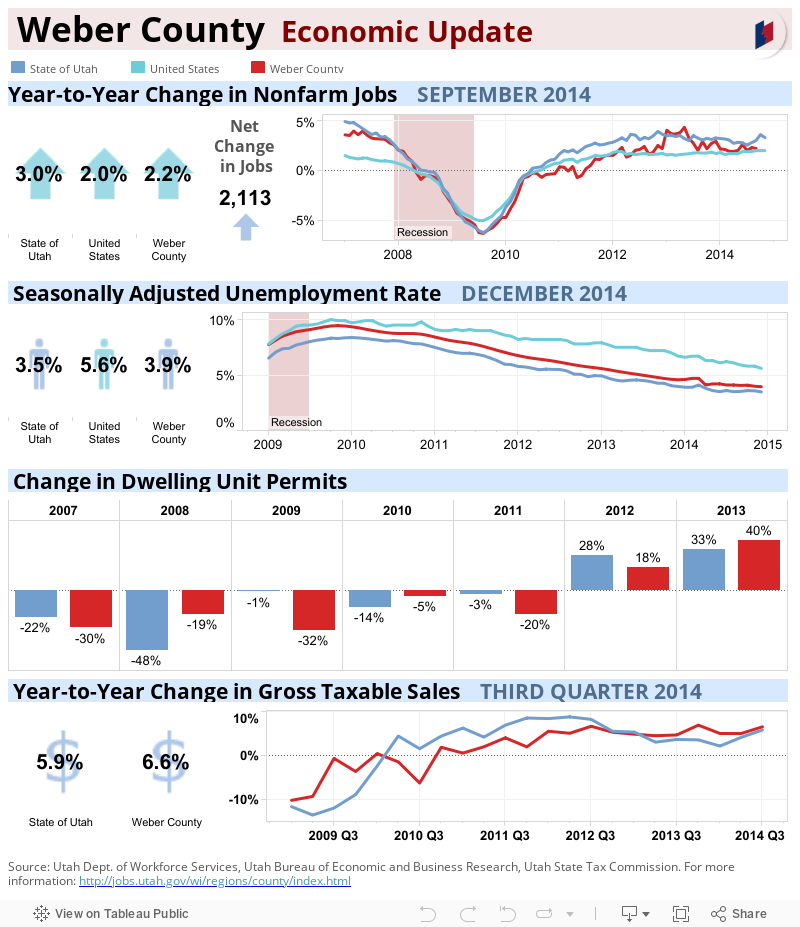
Weber County Economic Update

Weber County Starts 2015 With a Bang

By Matt Schroeder 

Weber County employment is growing at a rate not seen in more than 10 years and is very wide-spread across all industries. Taxable sales were up more than 6 percent with particular strength in retail markets suggesting that consumer confidence continues to build. Unemployment remains low and initial unemployment insurance claims are back to pre-recession levels. Overall, the indicators are reaffirming that the long term trajectory of economic performance for the county is very positive.

Morgan County Economic Update

Morgan County Continues Expansion in Early 2015

By Matt Schroeder

Morgan County continued robust economic expansion in early 2015. Employment grew at a faster rate than any other county in northern Utah.  Taxable sales were up 15 percent. Unemployment remains among the lowest in the state and initial unemployment insurance claims are back to pre-recession levels. Wage growth, although not great, is outpacing the rest of the state. Overall, the indicators are reaffirming that the long term trajectory of economic performance for the county is positive.

Davis County Economic Update

Davis County Kicks Off 2015 With Robust Gains

By Matt Schroeder


Davis County was strong out of the gate in early 2015. Job growth was robust and broad-based. Taxable sales were up 9.5 percent with particular strength in motor vehicles. Unemployment remains low and initial unemployment insurance claims are near pre-recession levels. Overall, the indicators are reaffirming that the long term trajectory of economic performance for the county is positive.


Monday, April 27, 2015

Weber County Economic Update

Weber County Ends 2014 with Strong Economic Performance

By Matt Schroeder

Weber County ended 2014 with signs of deepening economic strength and vitality. Wages, which have been slow to keep up with the rest of the recovering labor market, finally turned a corner. A considerable uptick in construction permits reveals positive expectations for housing demand. Taxable sales were up more than 5 percent with particular strength in retail markets suggesting that consumer confidence continues to build. Motor vehicle sales were particularly strong thanks in part to falling oil prices. Unemployment continues to fall and initial unemployment insurance claims are back to pre-recession levels. Employment growth was consistent and broad based. Overall, the roots of recovery appear to be firmly set in the region and Weber County’s economic performance at the end of 2014 leaves continued-optimism for 2015 as the rational expectation.

Morgan County Economic Update

Morgan County Ends 2014 with Strong Economic Performance

By Matt Schroeder

Morgan County ended 2014 on a very positive note. Employment grew at a faster rate than any other county in the state, and wages, which have been slow to keep up with the rest of the recovering labor market, picked up considerably. Taxable sales were up 26 percent. Unemployment was the second lowest in the state and initial unemployment insurance claims are back to pre-recession levels. Overall, the roots of recovery appear to be firmly set in the region and Morgan County’s economic performance at the end of 2014 leaves continued-optimism for 2015 as the rational expectation.

Davis County Economic Update

Davis County Ends 2014 with Strong Economic Performance

By Matt Schroeder


Davis County ended 2014 with healthy labor market expansion and indications of demand-side improvement. Wages, which have been slow to keep up with the rest of the recovering labor market, finally turned a corner. Taxable sales were up almost 7 percent with particular strength in motor vehicles thanks in part to falling oil prices. Unemployment continues to fall and initial unemployment insurance claims are near pre-recession levels. Employment growth was consistent and relatively broad based. Overall, the roots of recovery appear to be firmly set in the region and Davis County’s economic performance at the end of 2014 leaves continued-optimism for 2015 as the rational expectation.

Wednesday, February 11, 2015

Weber County Economic Update

The Wasatch Front North Edges Ever Closer to Full Recovery

By Matt Schroeder

Post-recession economic recoveries are long and arduous processes no matter what, but recessions involving financial crises are historically even slower.  Utah and the Wasatch Front North have been plugging along steadily for the last few years recovering jobs at an average rate of 2 to 3 percent per year and reaching a point where most counties have surpassed pre-recession levels.  Yet economists still talk in terms of recovery rather than in terms of normal economic expansion.  Why is that?  How do we know when the recovery is complete?

There are a variety of indicators that economists look at when determining the relative progress of a recovery.  One important one is the unemployment rate.  When the unemployment rate bottoms-out (i.e. when it stops falling), it may be a sign that labor markets have reached a “natural” or stable state, and thus recovered.  In the Wasatch Front North, the unemployment rate fell 0.6 percentage points from December 2013 to December 2014, indicating that the recovery may not yet be complete, but it continues to edge ever closer.    


Weber County
  • Weber County maintained steady, but relatively lackluster, employment growth of 2.2 percent year-over-year in the third quarter adding 2,076 jobs.  Manufacturing, construction, and professional and business services were the largest contributing industries adding 516, 469, and 487 jobs respectively, while government was a drag on employment growth with losses of 282 jobs since the third quarter last year.
  • The unemployment rate in Weber County fell slightly to 3.9 percent in December 2014, the first time it’s been below 4.0 percent since the third quarter 2008.  The rate has fallen almost 0.7 percentage points since the same time last year, but remains higher than the state unemployment rate of 3.5 percent.
  • The average number of initial unemployment claims filed per week in the fourth quarter of 2014 was 182 claims, about 75 fewer claims than the fourth quarter 2013 weekly average of 257 claims.
  • Although the labor market continues to tighten, average monthly wages are still slow to pick up coming in at 1.7 percent year-over-year growth in the third quarter 2014.  Weber County is in keeping with the average wage growth for the state which was 1.6 percent.  The average monthly wage in the third quarter was $3,103, not too far off from the state average of $3,429. 
  • Most industries have average wages that are comparable to the state level averages, but the wholesale trade and the professional, scientific, and technical services industries in Weber County have average monthly wages that come in well under the state level averages by 23 percent and 27 percent less respectively.
  • Taxable sales in the third quarter reached $960 million in Weber County, for an increase of 6.6 percent over the same quarter last year.  The manufacturing industry and the retail motor vehicles industry were the largest contributors each adding nearly $9 million in taxable sales compared to the third quarter 2013.
  

Tuesday, February 10, 2015

Morgan County Economic Update

The Wasatch Front North Edges Ever Closer to Full Recovery

By Matt Schroeder

Post-recession economic recoveries are long and arduous processes no matter what, but recessions involving financial crises are historically even slower.  Utah and the Wasatch Front North have been plugging along steadily for the last few years recovering jobs at an average rate of 2 to 3 percent per year and reaching a point where most counties have surpassed pre-recession levels.  Yet economists still talk in terms of recovery rather than in terms of normal economic expansion.  Why is that?  How do we know when the recovery is complete?

There are a variety of indicators that economists look at when determining the relative progress of a recovery.  One important one is the unemployment rate.  When the unemployment rate bottoms-out (i.e. when it stops falling), it may be a sign that labor markets have reached a “natural” or stable state, and thus recovered.  In the Wasatch Front North, the unemployment rate fell 0.6 percentage points from December 2013 to December 2014, indicating that the recovery may not yet be complete, but it continues to edge ever closer. 

Morgan County
  • Morgan County posted strong 7.2 percent year-over-year payroll job growth in the third quarter of 2014 adding 136 jobs to the economy over the last year and ranking as the second fastest growing county in the state in terms of employment. 
  • The accommodations and food services industry was particularly notable adding 75 jobs, and the professional, scientific, and technical services industry was also a major contributor, adding 50 new employees since the third quarter 2013.
  • December 2014 posted a 3.0 percent unemployment rate for Morgan County.  This is down 0.7 percentage points since December 2013.
  • The average number of initial unemployment claims filed per week in the fourth quarter of 2014 was 3 claims, about 3 fewer claims than the fourth quarter 2013 weekly average of 6 claims.
  • Average monthly wage growth decelerated in the third quarter to 1.2 percent year-over year, after growing 2.7 percent in the second quarter.  At $2,870 per month, the level remains below the state average of $3,429.  Average wages for the accommodations and food services industry, which accounts for more than 10 percent of payroll employment in Morgan County, fell by 24.3 percent year-over-year. 
  • Taxable sales in Morgan County were up a whopping 40 percent year-over-year reaching $25.3 million, after sales of $18.1 million in the same quarter last year.  The manufacturing industry was the largest contributor with $2.4 million in additional sales over the third quarter of 2013.
  

Davis County Economic Update

The Wasatch Front North Edges Ever Closer to Full Recovery

By Matt Schroeder

Post-recession economic recoveries are long and arduous processes no matter what, but recessions involving financial crises are historically even slower.  Utah and the Wasatch Front North have been plugging along steadily for the last few years recovering jobs at an average rate of 2 to 3 percent per year and reaching a point where most counties have surpassed pre-recession levels.  Yet economists still talk in terms of recovery rather than in terms of normal economic expansion.  Why is that?  How do we know when the recovery is complete?

There are a variety of indicators that economists look at when determining the relative progress of a recovery.  One important one is the unemployment rate.  When the unemployment rate bottoms-out (i.e. when it stops falling), it may be a sign that labor markets have reached a “natural” or stable state, and thus recovered.  In the Wasatch Front North, the unemployment rate fell 0.6 percentage points from December 2013 to December 2014, indicating that the recovery may not yet be complete, but it continues to edge ever closer.    

Davis County

  • Year-over-year payroll employment growth in Davis County accelerated to 3.6 percent in the third quarter of 2014 gaining momentum compared to the 3.2 percent growth of the second quarter.  The increase represents 4,030 more jobs compared to the same time last year with the construction industry leading the way adding 775 new jobs since the third quarter 2013.
  • Davis County’s unemployment rate continued on a downward trajectory to 3.3 percent in December.  This is more than a half percentage point drop since December 2013, and is well under the state average unemployment rate of 3.5 percent.
  • The average number of initial unemployment claims filed per week in the fourth quarter of 2014 was 139 claims, about 46 fewer claims than the fourth quarter 2013 weekly average of 185 claims.
  • Average monthly wages picked up to 3.2 percent year-over-year growth in the third quarter and outpaced statewide growth of 1.6 percent after having grown only 0.8 percent in the second quarter of 2014.  Davis County’s average monthly wage came in at $3,300, close to Utah’s average of $3,429.  Wage growth has remained relatively subdued over the course of the recovery, so the uptick is a welcome sign of potential improvement.
  • As employment strengthens and wages start to catch up, the expectation is that consumer and business spending will pick up as well and Davis County is no exception.  Year-over-year change in taxable sales showed strong growth of 8.3 percent in the third quarter, reaching nearly $1.19 billion.
  • The manufacturing industry increased sales by $10.8 million compared to the same quarter last year, and multiple retail industries including motor vehicles, clothing, food and beverages, and building materials were also large contributors with respective sales increases of $8.8, $7.0, $6.1, and $5.5 million.


Friday, December 5, 2014

Weber County Economic Update

Second quarter employment in the Wasatch Front North (WFN) region grew 2.7 percent from 2013 to 2014. The WFN increased employment at almost the same rate as the rest of the state, which grew 2.8 percent over the same period. In total, the region added 5,611 nonfarm payroll jobs year-over-year for a quarterly average of 213,346. Annual growth in the WFN slowed a bit from the 2.8 percent rate in the first quarter of 2014.
  • Second-quarter total nonfarm employment in Weber County increased 2.2 percent year-over-year. Total county employment in the second quarter was 96,963, a 2,050 job increase from the same period in 2013.
  • Private goods-producing employment increased 6.2 percent, or 1,070 jobs, from the second quarter of 2013. Manufacturing added 454 jobs, taking this industry’s employment from 12,361 in 2013 to 12,815 in 2014. Construction’s job total was 5,392 in the second quarter or 582 more jobs than a year earlier.
  • Private service-providing employment added 1,121 jobs, a growth rate of 2 percent from the previous year. The trade/transportation/utilities and educational/healthcare/social services industries increased employment by 534 and 300 jobs, respectively.
  • Government employment shrank 0.7 percent from the second quarter of 2013 to the second quarter of 2014. State and local governments added 55 and 30 positions respectively, while federal government lost a total of 226 jobs (declining 3.4 percent).
  • September’s unemployment rate for Weber County was 4.1 percent. Over the last year, the county unemployment rate has fallen 0.7 percentage points. Weber County was 0.6 percentage points higher than the state average in September.
  • On average, the number of initial unemployment claims filed per week in the second quarter (154) decreased by 16 claims from 2013 to 2014.  
  • Second-quarter taxable sales in the county increased 5.1 percent from 2013 to 2014. In the second quarter of 2014 taxable sales were approximately $913.7 million, which was an increase of approximately $44 million from the previous year.

Morgan County Economic Update

Second quarter employment in the Wasatch Front North (WFN) region grew 2.7 percent from 2013 to 2014. The WFN increased employment at almost the same rate as the rest of the state, which grew 2.8 percent over the same period. In total, the region added 5,611 nonfarm payroll jobs year-over-year for a quarterly average of 213,346. Annual growth in the WFN slowed a bit from the 2.8 percent rate in the first quarter of 2014.
  • Second-quarter total nonfarm employment in Morgan County grew 3.5 percent from 2013 to 2014. Morgan County added a quarterly average of 65 nonfarm jobs year-over-year, resulting in total employment equal to 1,943.
  • Private goods-producing employment increased 4.4 percent (23 more jobs). Construction employment, the region’s largest goods-producing industry, was up one job.
  • Private service-providing employment grew 7.8 percent from the second quarter of 2013, adding 68 jobs. Professional/business services increased by 33 jobs to an average quarterly employment total of 123.
  • Government employment in the second-quarter declined by 26 jobs, which were all reductions in local government (most losses, 23, were cuts in the school district).  
  • The unemployment rate in Morgan County was 3.3 percent in September. Since September 2013, the county unemployment rate has fallen 0.6 percentage points. Morgan County’s unemployment rate was slightly below the state average of 3.5 percent in September.
  • The average number of initial unemployment claims filed per week in the third quarter of 2014 was 2 claims, approximately 1 fewer claim than the 2013 average.
  • On a percentage basis, Morgan County had the fifth largest increase in second-quarter taxable sales. Taxable sales in the county jumped 12.8 percent from 2013 to 2014. Second-quarter spending was approximately $21.9 million, an increase of $2.5 million from the previous year.

Davis County Economic Update

Second quarter employment in the Wasatch Front North (WFN) region grew 2.7 percent from 2013 to 2014. The WFN increased employment at almost the same rate as the rest of the state, which grew 2.8 percent over the same period. In total, the region added 5,611 nonfarm payroll jobs year-over-year for a quarterly average of 213,346. Annual growth in the WFN slowed a bit from the 2.8 percent rate in the first quarter of 2014.
  • Total nonfarm employment in Davis County increased 3.2 percent year-over-year in the second quarter. From 2013 to 2014, Davis County added 3,496 jobs, resulting in a quarterly average of nonfarm employment equal to 114,439.
  • Private goods-producing employment increased 7.2 percent, or 1,340 jobs, since the second quarter of 2013. Construction and manufacturing added 870 and 444 jobs, respectively.
  • Private service-providing employment added 2,190 jobs year-over-year, a growth rate of 3.3 percent. The trade/transportation/utilities and the educational/healthcare/social services industries each tallied 652 and 583 new jobs.
  • Government employment shrank 0.1 percent from 2013 to 2014. Federal and local governments cut jobs, losing an average of 103 and one position respectively over the year. State government added 70 jobs over the year.
  • The Davis County unemployment rate settled at 3.3 percent in September 2014. Over the last 12-months the county unemployment rate has fallen 0.7 percentage points. Davis County was 0.2 percentage points lower than the state average in September.
  • On average, the number of weekly initial unemployment claims filed during the third quarter decreased by 24 claims from 2013 to 2014.
  • Spending in the county was also up; second-quarter taxable sales in the county increased 7.5 percent from 2013 to 2014, significantly higher than the state average of 4.2 percent. The year-over increase in spending was about $80 million higher than last year, bringing first quarter spending in 2014 to $1.15 billion.

Tuesday, July 22, 2014

New County Pages

See our new County Pages, each with their own URL for easy bookmarking. Find labor market information that has been divided into counties and regions for a quick look at each area.

Also find a new look for the Current Economic Snapshots (Davis, Morgan and Weber). These are economic snapshots are a two-page look at the current information for labor force, sales, building and unemployment insurance for each county in Utah, and are updated monthly after the Employment Situation.

These can be accessed on the Utah Economic Data page or on the Labor Market page under the "County Snapshots" link.

Friday, August 3, 2012

HomeDepot.com's Ogden service and sales center to open Saturday

One of HomeDepot.com’s two worldwide customer service and sales centers will officially open for business Saturday, eventually bringing over 700 jobs with it.

A “board-cutting” ceremony will be held at noon Saturday at the center’s recently completed 100,000-square-foot building in Business Depot Ogden, 801 Depot Drive.

Ogden Business Development Manager Steve Fishburn said the event will be attended by Utah Gov. Gary Herbert, Lt. Gov. Greg Bell, Mayor Mike Caldwell, other city officials and Hal Lawton, HomeDepot.com’s president and CEO.

Peter Makowski, a project coordinator with Ogden’s community and economic development department,
said HomeDepot.com has already hired 200 employees to fill positions that are immediately needed to begin operations, and the company hopes to fill 500 more positions by early next year. Standard Examiner