Showing posts with label Employment. Show all posts

Wednesday, January 27, 2016

How educated is the Wasatch Front North’s workforce?
It depends on how you look at it — based on where they work or where they live.

Matt Schroeder, Regional Economist

Local leaders have become increasingly aware of the relationship between the education level of their local workforce and the economic strength of their communities. Higher levels of education are closely linked to higher incomes for individuals; which, in turn, brings in higher tax revenues and lower government social program costs. People with higher education levels tend to be healthier, more involved in community organizations and give more to charity. They are also less likely to be chronically unemployed, less likely to require social assistance, and have lower incarceration rates.

More broadly, when businesses look to expand or locate in a particular area, one of the primary factors they consider is the availability and training of the local workforce. A region with a more highly educated labor pool will tend to draw businesses that need highly educated employees. Those jobs, in turn, tend to garner higher wages. Higher wages mean more consumer spending and tax revenue for local governments, which allow for investment in infrastructure, public services and community development.

These benefits have long been known and I mention them to highlight why so much emphasis is often placed on education in the public arena. It really matters for community health and development. But there is an interesting question to this issue that is seldom explored when we think about how to better educate our local workforce: Should we be focusing on the education levels of the people who live in our communities, or on those who work in our communities?
To clarify, we’re talking about community investment in increasing higher education attainment levels, not the funding of primary and secondary education. On the resident workforce side, this may include expanding post-secondary degree programs and institutions, or encouraging and supporting student enrollment in higher education. On the working workforce side, higher levels of educational attainment are achieved by growing the number of jobs that require higher levels of education. Community investments to achieve this may include developing infrastructure and facilities to meet the needs of businesses, incentives for target industries.

For a local city or county considering investing in these types of development projects with limited funds, where should their focus be? This is an especially relevant question in an area like the Wasatch Front North where the local commuting patterns are very fluid. Thousands of commuters flow (mostly south) along I-15 every day to jobs in other cities and counties. A well-educated economist, for example, may be living in Ogden, but commutes down to Salt Lake City every day for work. Should local leaders be concerned with developing a better-educated resident workforce if they are likely to commute somewhere else for work? Or should the community be more focused on bringing in the kinds of jobs that will help keep an already well-educated population working closer to home?

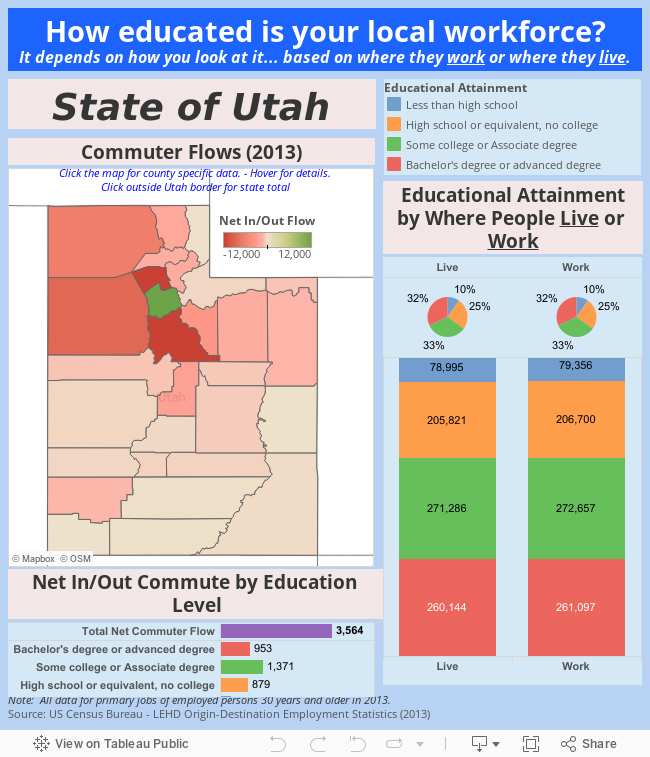
The answers to these questions depend on the specific characteristics of local economies, and unfortunately, no single answer or formula can be applied across the board. As a start, it helps to first have a picture of what’s actually happening. The interactive data visualization above allows you to see the situation for your county. Click on the map to see your county and hover over each chart to see details and an interpretation of the data.

In Davis, Morgan and Weber counties more people commute out for work than come in. Of the three, Davis County has the largest net outflow, with more than 26,000 net out-commuters representing about 30 percent of the resident workforce. Of those 26,000, more than 40 percent, or some 11,000 net out-commuters, have a bachelor’s degree or higher. The share of workers with a bachelor’s degree living in Davis County is 34 percent while the share working there is just 31 percent.

Morgan County sees the largest percentage of its resident workforce commute outside the county for work. The net out-flow of 1,800 workers represents more than 60 percent of the resident workforce and about 650 of those have a bachelor’s degree or higher. The share of workers with a bachelor’s degree or more living in Morgan County is 33 percent — 6 percentage-points higher than the 27 percent with the same level of education actually working in the county.

Weber County has the lowest rate of worker out-flow of the three counties. More people commute out for work than come in, but the net outflow of about 1,600 represents only 2.5 percent of the resident workforce, and about half of those are workers with a bachelor’s or higher.

Each of these counties is distinct in terms of the factors that play into why their worker flow patterns exist. For Davis and Morgan counties there is clearly a current resident population more educated than the local job market demands. It may be worth exploring the possibility that those areas may benefit from a greater focus on high-skilled job creation. Weber County, on the other hand, is currently balanced in terms of the share of highly educated workers that live and work there, but with a relatively low share in both, Weber may benefit most from a two-pronged approach that seeks to bring in higher skilled jobs while at the same time building the workforce to fill them.

Wednesday, November 4, 2015

Agricultural Employment – The Census of Agriculture Gives a More Complete Picture

By Matt Schroeder, Regional Economist

Farming, (or more generally, agriculture) is obviously an important part of the economy, so why is that when you hear employment statistics reported in the news, you typically hear them reported as “nonfarm” employment?

“Nonfarm payroll employment” is terminology from the Bureau of Labor Statistics’ Quarterly Census of Employment and Wages (QCEW), and the term is slightly misleading. There is, in fact, some data on agricultural employment in the QCEW data typically reported, it’s just not complete. QCEW employment data is based on administrative records from employers who pay into the state’s Unemployment Insurance (UI) program, so workers not covered under UI laws are not captured. Agricultural employers are generally exempt from the requirements for UI coverage, so the data are simply not comprehensive enough to calculate reliable estimates. Furthermore, many agricultural operations are sole-proprietorships that are also exempt from UI coverage (whether in agriculture or not), so those individuals are not recorded either.

All of this comes down to the fact that the typical “nonfarm” employment statistics you hear about in the news, on average, do not include roughly 90 percent of Utah’s agricultural employment. In 2012, QCEW reported fewer than 5,000 employees in “Covered Agriculture” for the whole state, which represented less than one half of one percent of Utah’s total employment.

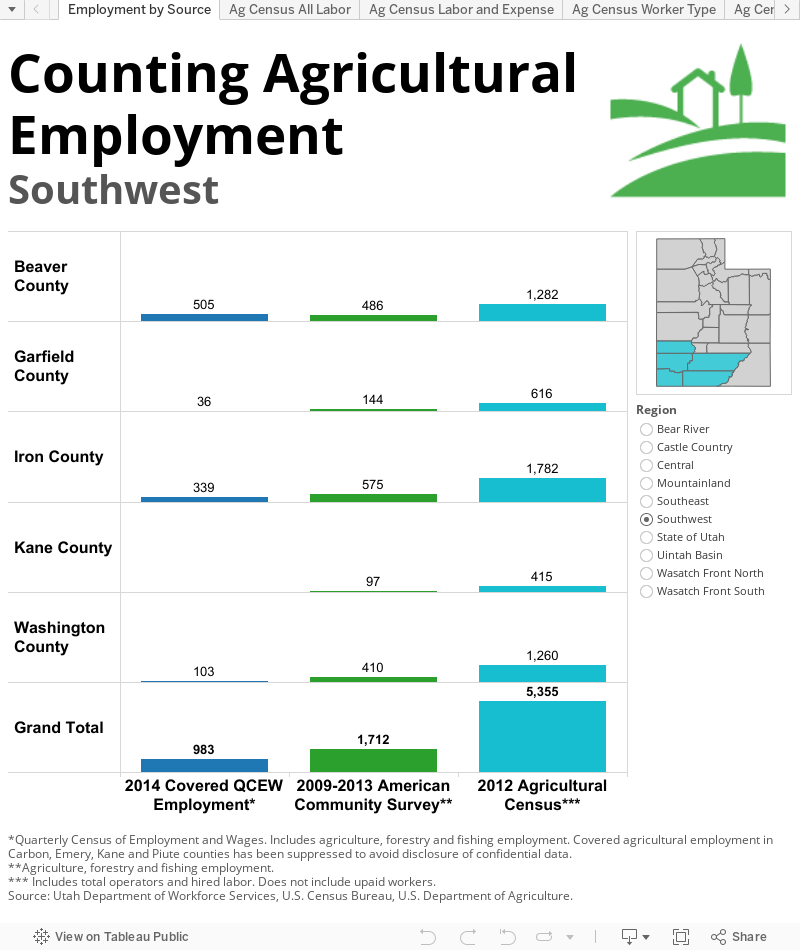
Fortunately, the Census of Agriculture, conducted by the U.S. Department of Agriculture once every five years, gives a revealing picture of the agricultural sector. The most recent data, covering 2012, were released last May 2015. The Agricultural Census surveys all of those UI-exempt farms that the QCEW misses and found that there were nearly 47,000 jobs in agriculture in 2012 — more than 3.5 percent of Utah’s total employment.

The share is not quite as large in the Wasatch Front North region, where agriculture represents about 2.6 percent of the local economy — according to the Census of Agriculture. But this is a much larger share than the 0.4 percent suggested by the QCEW. Weber and Davis counties respectively rank 4th and 9th in the state in terms of total agricultural employment. Morgan County is relatively small in total number, but agriculture’s share of all Morgan County jobs is more than 30 percent.

Monday, August 3, 2015

Weber County Economic Update

Weber County Starts 2015 With a Bang

By Matt Schroeder 

Weber County employment is growing at a rate not seen in more than 10 years and is very wide-spread across all industries. Taxable sales were up more than 6 percent with particular strength in retail markets suggesting that consumer confidence continues to build. Unemployment remains low and initial unemployment insurance claims are back to pre-recession levels. Overall, the indicators are reaffirming that the long term trajectory of economic performance for the county is very positive.

Morgan County Economic Update

Morgan County Continues Expansion in Early 2015

By Matt Schroeder

Morgan County continued robust economic expansion in early 2015. Employment grew at a faster rate than any other county in northern Utah.  Taxable sales were up 15 percent. Unemployment remains among the lowest in the state and initial unemployment insurance claims are back to pre-recession levels. Wage growth, although not great, is outpacing the rest of the state. Overall, the indicators are reaffirming that the long term trajectory of economic performance for the county is positive.

Davis County Economic Update

Davis County Kicks Off 2015 With Robust Gains

By Matt Schroeder


Davis County was strong out of the gate in early 2015. Job growth was robust and broad-based. Taxable sales were up 9.5 percent with particular strength in motor vehicles. Unemployment remains low and initial unemployment insurance claims are near pre-recession levels. Overall, the indicators are reaffirming that the long term trajectory of economic performance for the county is positive.


Monday, April 27, 2015

Weber County Economic Update

Weber County Ends 2014 with Strong Economic Performance

By Matt Schroeder

Weber County ended 2014 with signs of deepening economic strength and vitality. Wages, which have been slow to keep up with the rest of the recovering labor market, finally turned a corner. A considerable uptick in construction permits reveals positive expectations for housing demand. Taxable sales were up more than 5 percent with particular strength in retail markets suggesting that consumer confidence continues to build. Motor vehicle sales were particularly strong thanks in part to falling oil prices. Unemployment continues to fall and initial unemployment insurance claims are back to pre-recession levels. Employment growth was consistent and broad based. Overall, the roots of recovery appear to be firmly set in the region and Weber County’s economic performance at the end of 2014 leaves continued-optimism for 2015 as the rational expectation.

Morgan County Economic Update

Morgan County Ends 2014 with Strong Economic Performance

By Matt Schroeder

Morgan County ended 2014 on a very positive note. Employment grew at a faster rate than any other county in the state, and wages, which have been slow to keep up with the rest of the recovering labor market, picked up considerably. Taxable sales were up 26 percent. Unemployment was the second lowest in the state and initial unemployment insurance claims are back to pre-recession levels. Overall, the roots of recovery appear to be firmly set in the region and Morgan County’s economic performance at the end of 2014 leaves continued-optimism for 2015 as the rational expectation.

Davis County Economic Update

Davis County Ends 2014 with Strong Economic Performance

By Matt Schroeder


Davis County ended 2014 with healthy labor market expansion and indications of demand-side improvement. Wages, which have been slow to keep up with the rest of the recovering labor market, finally turned a corner. Taxable sales were up almost 7 percent with particular strength in motor vehicles thanks in part to falling oil prices. Unemployment continues to fall and initial unemployment insurance claims are near pre-recession levels. Employment growth was consistent and relatively broad based. Overall, the roots of recovery appear to be firmly set in the region and Davis County’s economic performance at the end of 2014 leaves continued-optimism for 2015 as the rational expectation.