Showing posts with label Unemployment. Show all posts

Wednesday, June 3, 2020

Unemployment Insurance Claims Data Shed Light on the Local Economic Impacts of the COVID-19 Pandemic


Unemployment Insurance Claims Data Shed Light on the Local Economic Impacts of the COVID-19 Pandemic

By Lecia Parks Langston, Senior Economist; Michael Jeanfreau, Regional Economist

“You have power over your mind — not outside events. Realize this, and you will find strength.” Marcus Aurelius

In the wake of the COVID-19 pandemic, businesses lost revenues and workers lost jobs. But because of the time it takes to collect and collate data, economists have been left without much information to quantify the economic impacts at the local level.

But there is one ray of data illumination. Claims for unemployment benefits are promptly available and provide information about a large cross section of the economy. This post will outline what light unemployment claims data sheds on the state of Utah’s Wasatch Front North economy.

While not all workers are protected by unemployment insurance laws, roughly 95% of jobs are covered. This makes claims data an exceptional source of information about the economy. Not included under unemployment insurance laws are most self-employed workers, about half of agricultural employment, unpaid family workers, railroad personnel (covered separately) and many nonprofit organizations (such as churches). Also, some out-of-work employees may not have worked a sufficient work history to qualify for unemployment insurance benefits, but may file anyway. Fortunately, in this time of economic distress, the social safety nets of the unemployment insurance program, special national COVID-19 funding and social programs are working together to keep workers’ income and well-being stable.

Unemployment claimants and the unemployed; they aren’t the same

Also, keep in mind that, in addition to individuals drawing unemployment benefits, the unemployment rate includes those entering and re-entering the workforce and noncovered groups without current employment. This means the number of “unemployed” will be greater than the number of claimants. In “normal” times, only about 40% of the “unemployed” are claiming benefits. The generally reported unemployment rate also has a work-search requirement. If you haven’t made any minimal attempts to find work, you aren’t counted as “unemployed.”

Watch this Space

While this analysis won’t be updated on a regular basis, new data will be added to the data visualization on a weekly basis allowing readers to check back for the latest information.

An Unprecedented Event

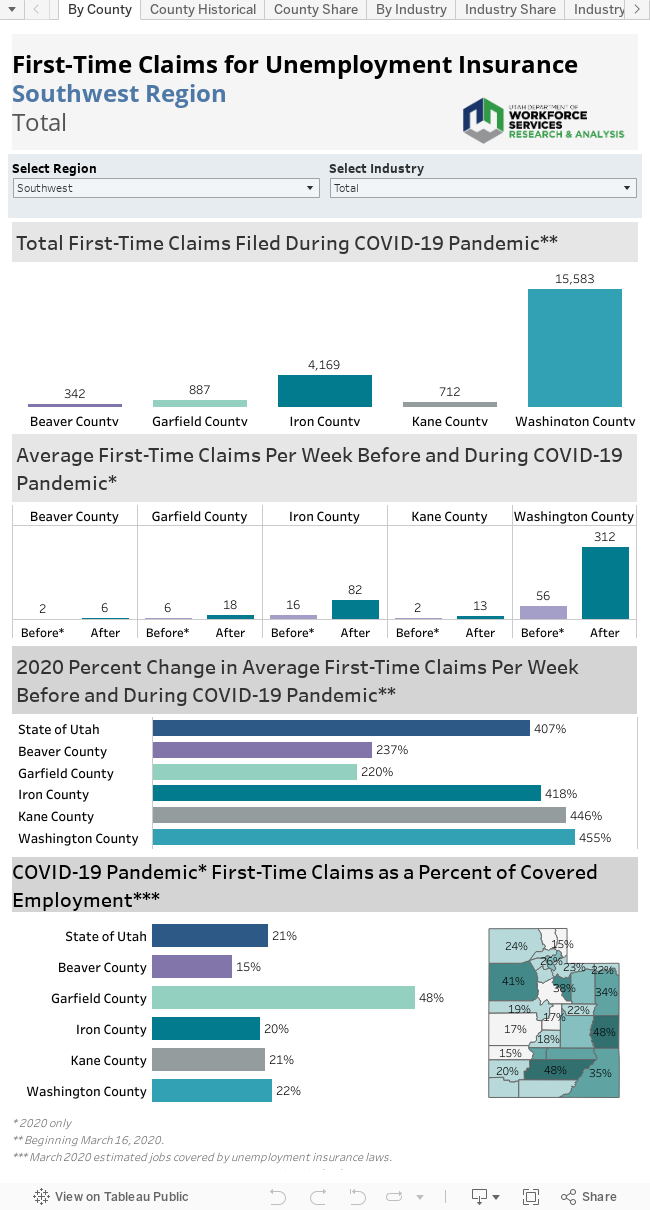
Not surprisingly, first-time claims for unemployment benefits have soared in Utah and across the nation as the pandemic swept across the country. This increase is unprecedented since the creation of unemployment insurance coverage during the Great Depression. Week 12 (beginning March 16) marks the start of this unparalleled surge in claims. On a positive note, while new claims for unemployment benefits have skyrocketed in Utah, the state currently shows one of the lowest claims rates in the nation.

For most Wasatch Front North counties, initial claims peaked in week 14 (starting March 30) and have since tapered downward. During the peak, initial claims filed totaled 5,744 in the region. By week 19, claims measured considerably lower but continued to run substantially greater than in previous years — even during the “Great Recession.”

Here’s another example of the tremendous flood of new claims. Prior to the COVID-19 pandemic, counties in Wasatch Front North Utah averaged a total of 240 first-time claims per week. This time period included seasonally high claims weeks in January. In the weeks after, an average of 3,342 claims were filed for a staggering increase of 1,392%.

Who took the hardest hit?

Each county in the Wasatch Front North region has had a different industry leading the total number of claims in the area. Overall, manufacturing lead total initial claims at 13%, followed by both health care/social assistance and retail trade at 12%, with food service/accommodation following at 11%. Additionally, claims from unknown industries are also prevalent, representing 12% of total initial claims. These claims will mostly fall into the food service industry.

The Domino Effect of COVID-19

In the early stages of the pandemic, this was a story of service-dependent industries. However, the domino effect of the COVID-19 pandemic have also begun to have large impacts in other industries. Claims have been distributed fairly evenly among different industries, with manufacturing, health care/social assistance, retail trade, accommodation/foodservice and claims from “unknown” industries as the top five industries impacted within each county in the Wasatch Front North region. Many of these unclassified claims would rightfully be counted among accommodations/food services if the appropriate information were available.

The initial impact of the pandemic led to the closure of face-to-face jobs, but the change in employment and social behavior both locally and abroad has led to subsequent closures in other industries. Industries that didn’t face instructions to alter behavior during this event still had to adapt to the difference in consumer behavior, supply chains and additional safety precautions.

The Industry Flow

Initial claims in the region have come in waves, with food service/accommodation and unknown claims peaking in week 12, followed by an uptick in claims from nonessential health care services and retail trade through weeks 13 and 14, and lastly a marked increase in manufacturing by week 15.

The High and the Low

Although the largest numbers of claims in Wasatch Front North have come from manufacturing, health care/social assistance, retail trade and food services, in percentage terms, other industries have actually suffered more. For example, in the smaller industries of mining, real estate/rental and leasing, information and personal care services have all seen similar losses of between 16-19% of total covered employment.

Because of its job-to-job nature, the construction industry typically accounts for 15-25% of first-time claims. However, although construction’s new claims have also increased, they have increased at a much slower-than-average rate. After the COVID-19 pandemic hit, construction contributed less than 4% of all first-time claims. Ease of social-distancing and good weather have helped construction maintain employment levels. New claims measured just 5% of covered construction employment.

Only a portion of agricultural employment is covered by unemployment insurance laws. However, as companies work to keep America fed, agribusiness has laid off few employees. Only 2% of Wasatch Front North’s covered agricultural workers have filed a claim during the COVID-19 pandemic.


Public administration, educational services (including public and higher education), finance/insurance and utilities have also managed to keep a higher percentage of their workforces employed.


County by County

Davis County
  • Davis County matched the state average for new claims as a share of covered employment (10%). While the whole region suffered similar initial losses, Davis County was largely spared the increase in manufacturing claims that Weber County experienced in the weeks following the arrival of the COVID-19 pandemic.
  • While the percent of covered employment is lower in Davis County, it had the largest total initial claims in the region (13,951), narrowly beating out Weber County (12,451).
  • Prior to the COVID-19 pandemic, Davis County averaged 104 first-time claims per week compared with 1,744 claims after the pandemic. This increase of 1,581% ranked as the largest in the region.
  • Retail trade, health care/social services and accommodation/food services generated the highest number of initial claims during the pandemic.
  • Davis County’s initial claims peaked on week 14, totaling 3,081. This was the only week that claims rose over 3,000.
  • The regional share of new claims that Davis County had rose from before 43% of claims to 52% during the pandemic.

Morgan County
  • Prior to the COVID-19 slowdown, Morgan County averaged three unemployment insurance claims per week compared to 42 new claims afterward, an increase of 1,071%.
  • Because of its relatively large share of service industry employment, Morgan County has shown a higher-than-average increase in claims due to the COVID-19 pandemic.
  • New claims as a percent of covered employment measured at 13% — above the state average of 10%.
  • Morgan was slightly unusual compared to other areas, with health care/social assistance receiving more initial claims than food service/accommodation industry.
  • In counties with small workforces, the lack of data accuracy can make an impact to volatility. In Morgan County, the initial claims data show claims from an overwhelming percentage of covered employment in both entertainment and management of companies.
  • Morgan County remained a meager 1% of total first-time claims for the region during the COVID-19 pandemic.


Weber County
  • While Weber County and Davis County are the two large contributors to employment numbers in the region, Weber County has had 12,451 total first-time claims filed during the COVID-19 pandemic. While this is only slightly less than Davis County (13,951), Weber County’s share of first-time claims within the entire region dropped before and during the COVID-19 slowdown from 55% of all claims before to 47% of all claims during. This means that, while Weber County’s claims increased proportionately less than other counties in the region.
  • Before the slowdown, an average of 133 initial claims were being filed in Weber County compared to an average of 994 claims in the following weeks. The pre-to-post-pandemic increase registered at 1,339%
  •  Initial claims for unemployment insurance filed during the pandemic as a percent of covered employment measured at 11%, near the middle of a ranking of all Utah counties.
  • Weber County had more first-time claims filed during the pandemic from the manufacturing (2,376) and health care/social assistance (1,470) industries than the more common accommodation/food services.
  • While the total claims are higher in other industries, several industries suffered larger portions of claims as a percent of covered employment. Real estate/rental and leasing saw claims from 19% of covered employment, while industries designated as “other services” received the same. In this case, these claims will largely be coming from personal beauty services, a subset of “other services.” Information (18%), mining (16%) and accommodation/food service (16%) all similarly saw claims from a high percent of covered employment.
  • Claims originating from manufacturing and transportation surged towards the latter weeks of the pandemic time period.



Monday, March 5, 2018

Utah's Seasonally Adjusted Unemployment Rates

Seasonally adjusted unemployment rates for all Utah counties have been posted online here.

Each month, these rates are posted the Monday following the Unemployment Rate Update for Utah.

For more information about seasonally adjusted rates, read a DWS analysis here.

Next update scheduled for March 26th.

Friday, March 2, 2018

Utah's Employment Situation for January 2018

Utah's Employment Situation for January 2018 has been released on the web.

Find the Current Economic Situation in its entirety here.

For charts and tables, including County Employment, go to the Employment and Unemployment page.

Next update scheduled for March 23rd, 2018.


Monday, August 3, 2015

Weber County Economic Update

Weber County Starts 2015 With a Bang

By Matt Schroeder 

Weber County employment is growing at a rate not seen in more than 10 years and is very wide-spread across all industries. Taxable sales were up more than 6 percent with particular strength in retail markets suggesting that consumer confidence continues to build. Unemployment remains low and initial unemployment insurance claims are back to pre-recession levels. Overall, the indicators are reaffirming that the long term trajectory of economic performance for the county is very positive.

Morgan County Economic Update

Morgan County Continues Expansion in Early 2015

By Matt Schroeder

Morgan County continued robust economic expansion in early 2015. Employment grew at a faster rate than any other county in northern Utah.  Taxable sales were up 15 percent. Unemployment remains among the lowest in the state and initial unemployment insurance claims are back to pre-recession levels. Wage growth, although not great, is outpacing the rest of the state. Overall, the indicators are reaffirming that the long term trajectory of economic performance for the county is positive.

Davis County Economic Update

Davis County Kicks Off 2015 With Robust Gains

By Matt Schroeder


Davis County was strong out of the gate in early 2015. Job growth was robust and broad-based. Taxable sales were up 9.5 percent with particular strength in motor vehicles. Unemployment remains low and initial unemployment insurance claims are near pre-recession levels. Overall, the indicators are reaffirming that the long term trajectory of economic performance for the county is positive.


Monday, April 27, 2015

Weber County Economic Update

Weber County Ends 2014 with Strong Economic Performance

By Matt Schroeder

Weber County ended 2014 with signs of deepening economic strength and vitality. Wages, which have been slow to keep up with the rest of the recovering labor market, finally turned a corner. A considerable uptick in construction permits reveals positive expectations for housing demand. Taxable sales were up more than 5 percent with particular strength in retail markets suggesting that consumer confidence continues to build. Motor vehicle sales were particularly strong thanks in part to falling oil prices. Unemployment continues to fall and initial unemployment insurance claims are back to pre-recession levels. Employment growth was consistent and broad based. Overall, the roots of recovery appear to be firmly set in the region and Weber County’s economic performance at the end of 2014 leaves continued-optimism for 2015 as the rational expectation.

Morgan County Economic Update

Morgan County Ends 2014 with Strong Economic Performance

By Matt Schroeder

Morgan County ended 2014 on a very positive note. Employment grew at a faster rate than any other county in the state, and wages, which have been slow to keep up with the rest of the recovering labor market, picked up considerably. Taxable sales were up 26 percent. Unemployment was the second lowest in the state and initial unemployment insurance claims are back to pre-recession levels. Overall, the roots of recovery appear to be firmly set in the region and Morgan County’s economic performance at the end of 2014 leaves continued-optimism for 2015 as the rational expectation.

Davis County Economic Update

Davis County Ends 2014 with Strong Economic Performance

By Matt Schroeder


Davis County ended 2014 with healthy labor market expansion and indications of demand-side improvement. Wages, which have been slow to keep up with the rest of the recovering labor market, finally turned a corner. Taxable sales were up almost 7 percent with particular strength in motor vehicles thanks in part to falling oil prices. Unemployment continues to fall and initial unemployment insurance claims are near pre-recession levels. Employment growth was consistent and relatively broad based. Overall, the roots of recovery appear to be firmly set in the region and Davis County’s economic performance at the end of 2014 leaves continued-optimism for 2015 as the rational expectation.

Wednesday, February 11, 2015

Weber County Economic Update

The Wasatch Front North Edges Ever Closer to Full Recovery

By Matt Schroeder

Post-recession economic recoveries are long and arduous processes no matter what, but recessions involving financial crises are historically even slower.  Utah and the Wasatch Front North have been plugging along steadily for the last few years recovering jobs at an average rate of 2 to 3 percent per year and reaching a point where most counties have surpassed pre-recession levels.  Yet economists still talk in terms of recovery rather than in terms of normal economic expansion.  Why is that?  How do we know when the recovery is complete?

There are a variety of indicators that economists look at when determining the relative progress of a recovery.  One important one is the unemployment rate.  When the unemployment rate bottoms-out (i.e. when it stops falling), it may be a sign that labor markets have reached a “natural” or stable state, and thus recovered.  In the Wasatch Front North, the unemployment rate fell 0.6 percentage points from December 2013 to December 2014, indicating that the recovery may not yet be complete, but it continues to edge ever closer.    


Weber County
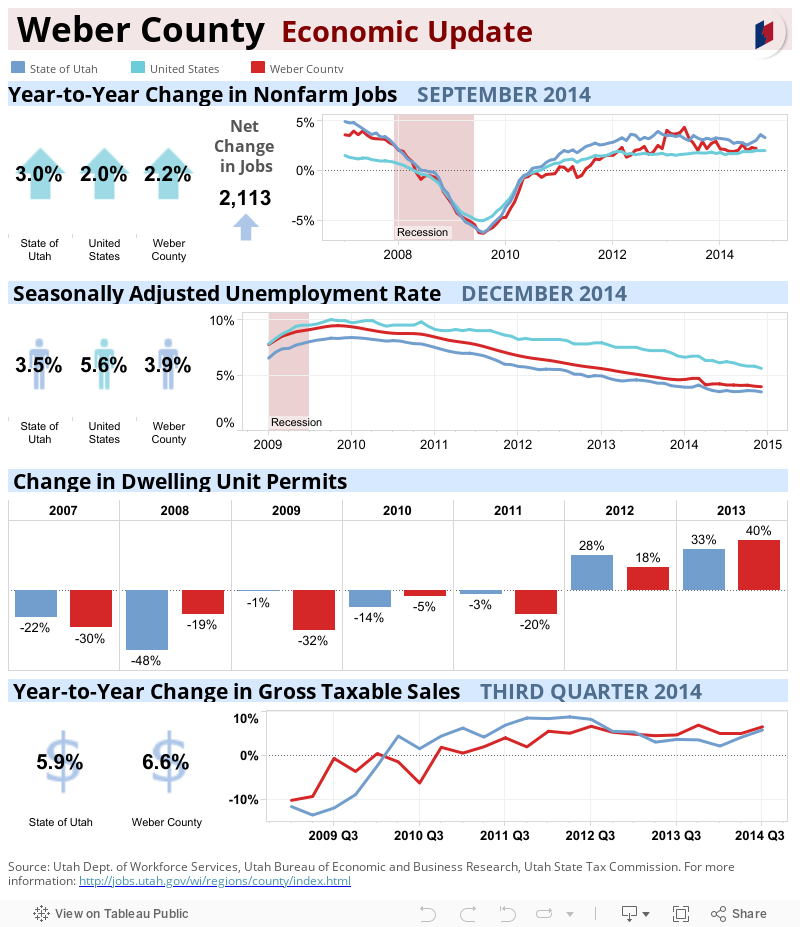
  • Weber County maintained steady, but relatively lackluster, employment growth of 2.2 percent year-over-year in the third quarter adding 2,076 jobs.  Manufacturing, construction, and professional and business services were the largest contributing industries adding 516, 469, and 487 jobs respectively, while government was a drag on employment growth with losses of 282 jobs since the third quarter last year.
  • The unemployment rate in Weber County fell slightly to 3.9 percent in December 2014, the first time it’s been below 4.0 percent since the third quarter 2008.  The rate has fallen almost 0.7 percentage points since the same time last year, but remains higher than the state unemployment rate of 3.5 percent.
  • The average number of initial unemployment claims filed per week in the fourth quarter of 2014 was 182 claims, about 75 fewer claims than the fourth quarter 2013 weekly average of 257 claims.
  • Although the labor market continues to tighten, average monthly wages are still slow to pick up coming in at 1.7 percent year-over-year growth in the third quarter 2014.  Weber County is in keeping with the average wage growth for the state which was 1.6 percent.  The average monthly wage in the third quarter was $3,103, not too far off from the state average of $3,429. 
  • Most industries have average wages that are comparable to the state level averages, but the wholesale trade and the professional, scientific, and technical services industries in Weber County have average monthly wages that come in well under the state level averages by 23 percent and 27 percent less respectively.
  • Taxable sales in the third quarter reached $960 million in Weber County, for an increase of 6.6 percent over the same quarter last year.  The manufacturing industry and the retail motor vehicles industry were the largest contributors each adding nearly $9 million in taxable sales compared to the third quarter 2013.
  

Tuesday, February 10, 2015

Morgan County Economic Update

The Wasatch Front North Edges Ever Closer to Full Recovery

By Matt Schroeder

Post-recession economic recoveries are long and arduous processes no matter what, but recessions involving financial crises are historically even slower.  Utah and the Wasatch Front North have been plugging along steadily for the last few years recovering jobs at an average rate of 2 to 3 percent per year and reaching a point where most counties have surpassed pre-recession levels.  Yet economists still talk in terms of recovery rather than in terms of normal economic expansion.  Why is that?  How do we know when the recovery is complete?

There are a variety of indicators that economists look at when determining the relative progress of a recovery.  One important one is the unemployment rate.  When the unemployment rate bottoms-out (i.e. when it stops falling), it may be a sign that labor markets have reached a “natural” or stable state, and thus recovered.  In the Wasatch Front North, the unemployment rate fell 0.6 percentage points from December 2013 to December 2014, indicating that the recovery may not yet be complete, but it continues to edge ever closer. 

Morgan County
  • Morgan County posted strong 7.2 percent year-over-year payroll job growth in the third quarter of 2014 adding 136 jobs to the economy over the last year and ranking as the second fastest growing county in the state in terms of employment. 
  • The accommodations and food services industry was particularly notable adding 75 jobs, and the professional, scientific, and technical services industry was also a major contributor, adding 50 new employees since the third quarter 2013.
  • December 2014 posted a 3.0 percent unemployment rate for Morgan County.  This is down 0.7 percentage points since December 2013.
  • The average number of initial unemployment claims filed per week in the fourth quarter of 2014 was 3 claims, about 3 fewer claims than the fourth quarter 2013 weekly average of 6 claims.
  • Average monthly wage growth decelerated in the third quarter to 1.2 percent year-over year, after growing 2.7 percent in the second quarter.  At $2,870 per month, the level remains below the state average of $3,429.  Average wages for the accommodations and food services industry, which accounts for more than 10 percent of payroll employment in Morgan County, fell by 24.3 percent year-over-year. 
  • Taxable sales in Morgan County were up a whopping 40 percent year-over-year reaching $25.3 million, after sales of $18.1 million in the same quarter last year.  The manufacturing industry was the largest contributor with $2.4 million in additional sales over the third quarter of 2013.
  

Davis County Economic Update

The Wasatch Front North Edges Ever Closer to Full Recovery

By Matt Schroeder

Post-recession economic recoveries are long and arduous processes no matter what, but recessions involving financial crises are historically even slower.  Utah and the Wasatch Front North have been plugging along steadily for the last few years recovering jobs at an average rate of 2 to 3 percent per year and reaching a point where most counties have surpassed pre-recession levels.  Yet economists still talk in terms of recovery rather than in terms of normal economic expansion.  Why is that?  How do we know when the recovery is complete?

There are a variety of indicators that economists look at when determining the relative progress of a recovery.  One important one is the unemployment rate.  When the unemployment rate bottoms-out (i.e. when it stops falling), it may be a sign that labor markets have reached a “natural” or stable state, and thus recovered.  In the Wasatch Front North, the unemployment rate fell 0.6 percentage points from December 2013 to December 2014, indicating that the recovery may not yet be complete, but it continues to edge ever closer.    

Davis County

  • Year-over-year payroll employment growth in Davis County accelerated to 3.6 percent in the third quarter of 2014 gaining momentum compared to the 3.2 percent growth of the second quarter.  The increase represents 4,030 more jobs compared to the same time last year with the construction industry leading the way adding 775 new jobs since the third quarter 2013.
  • Davis County’s unemployment rate continued on a downward trajectory to 3.3 percent in December.  This is more than a half percentage point drop since December 2013, and is well under the state average unemployment rate of 3.5 percent.
  • The average number of initial unemployment claims filed per week in the fourth quarter of 2014 was 139 claims, about 46 fewer claims than the fourth quarter 2013 weekly average of 185 claims.
  • Average monthly wages picked up to 3.2 percent year-over-year growth in the third quarter and outpaced statewide growth of 1.6 percent after having grown only 0.8 percent in the second quarter of 2014.  Davis County’s average monthly wage came in at $3,300, close to Utah’s average of $3,429.  Wage growth has remained relatively subdued over the course of the recovery, so the uptick is a welcome sign of potential improvement.
  • As employment strengthens and wages start to catch up, the expectation is that consumer and business spending will pick up as well and Davis County is no exception.  Year-over-year change in taxable sales showed strong growth of 8.3 percent in the third quarter, reaching nearly $1.19 billion.
  • The manufacturing industry increased sales by $10.8 million compared to the same quarter last year, and multiple retail industries including motor vehicles, clothing, food and beverages, and building materials were also large contributors with respective sales increases of $8.8, $7.0, $6.1, and $5.5 million.


Friday, December 5, 2014

Weber County Economic Update

Second quarter employment in the Wasatch Front North (WFN) region grew 2.7 percent from 2013 to 2014. The WFN increased employment at almost the same rate as the rest of the state, which grew 2.8 percent over the same period. In total, the region added 5,611 nonfarm payroll jobs year-over-year for a quarterly average of 213,346. Annual growth in the WFN slowed a bit from the 2.8 percent rate in the first quarter of 2014.
  • Second-quarter total nonfarm employment in Weber County increased 2.2 percent year-over-year. Total county employment in the second quarter was 96,963, a 2,050 job increase from the same period in 2013.
  • Private goods-producing employment increased 6.2 percent, or 1,070 jobs, from the second quarter of 2013. Manufacturing added 454 jobs, taking this industry’s employment from 12,361 in 2013 to 12,815 in 2014. Construction’s job total was 5,392 in the second quarter or 582 more jobs than a year earlier.
  • Private service-providing employment added 1,121 jobs, a growth rate of 2 percent from the previous year. The trade/transportation/utilities and educational/healthcare/social services industries increased employment by 534 and 300 jobs, respectively.
  • Government employment shrank 0.7 percent from the second quarter of 2013 to the second quarter of 2014. State and local governments added 55 and 30 positions respectively, while federal government lost a total of 226 jobs (declining 3.4 percent).
  • September’s unemployment rate for Weber County was 4.1 percent. Over the last year, the county unemployment rate has fallen 0.7 percentage points. Weber County was 0.6 percentage points higher than the state average in September.
  • On average, the number of initial unemployment claims filed per week in the second quarter (154) decreased by 16 claims from 2013 to 2014.  
  • Second-quarter taxable sales in the county increased 5.1 percent from 2013 to 2014. In the second quarter of 2014 taxable sales were approximately $913.7 million, which was an increase of approximately $44 million from the previous year.

Morgan County Economic Update

Second quarter employment in the Wasatch Front North (WFN) region grew 2.7 percent from 2013 to 2014. The WFN increased employment at almost the same rate as the rest of the state, which grew 2.8 percent over the same period. In total, the region added 5,611 nonfarm payroll jobs year-over-year for a quarterly average of 213,346. Annual growth in the WFN slowed a bit from the 2.8 percent rate in the first quarter of 2014.
  • Second-quarter total nonfarm employment in Morgan County grew 3.5 percent from 2013 to 2014. Morgan County added a quarterly average of 65 nonfarm jobs year-over-year, resulting in total employment equal to 1,943.
  • Private goods-producing employment increased 4.4 percent (23 more jobs). Construction employment, the region’s largest goods-producing industry, was up one job.
  • Private service-providing employment grew 7.8 percent from the second quarter of 2013, adding 68 jobs. Professional/business services increased by 33 jobs to an average quarterly employment total of 123.
  • Government employment in the second-quarter declined by 26 jobs, which were all reductions in local government (most losses, 23, were cuts in the school district).  
  • The unemployment rate in Morgan County was 3.3 percent in September. Since September 2013, the county unemployment rate has fallen 0.6 percentage points. Morgan County’s unemployment rate was slightly below the state average of 3.5 percent in September.
  • The average number of initial unemployment claims filed per week in the third quarter of 2014 was 2 claims, approximately 1 fewer claim than the 2013 average.
  • On a percentage basis, Morgan County had the fifth largest increase in second-quarter taxable sales. Taxable sales in the county jumped 12.8 percent from 2013 to 2014. Second-quarter spending was approximately $21.9 million, an increase of $2.5 million from the previous year.

Davis County Economic Update

Second quarter employment in the Wasatch Front North (WFN) region grew 2.7 percent from 2013 to 2014. The WFN increased employment at almost the same rate as the rest of the state, which grew 2.8 percent over the same period. In total, the region added 5,611 nonfarm payroll jobs year-over-year for a quarterly average of 213,346. Annual growth in the WFN slowed a bit from the 2.8 percent rate in the first quarter of 2014.
  • Total nonfarm employment in Davis County increased 3.2 percent year-over-year in the second quarter. From 2013 to 2014, Davis County added 3,496 jobs, resulting in a quarterly average of nonfarm employment equal to 114,439.
  • Private goods-producing employment increased 7.2 percent, or 1,340 jobs, since the second quarter of 2013. Construction and manufacturing added 870 and 444 jobs, respectively.
  • Private service-providing employment added 2,190 jobs year-over-year, a growth rate of 3.3 percent. The trade/transportation/utilities and the educational/healthcare/social services industries each tallied 652 and 583 new jobs.
  • Government employment shrank 0.1 percent from 2013 to 2014. Federal and local governments cut jobs, losing an average of 103 and one position respectively over the year. State government added 70 jobs over the year.
  • The Davis County unemployment rate settled at 3.3 percent in September 2014. Over the last 12-months the county unemployment rate has fallen 0.7 percentage points. Davis County was 0.2 percentage points lower than the state average in September.
  • On average, the number of weekly initial unemployment claims filed during the third quarter decreased by 24 claims from 2013 to 2014.
  • Spending in the county was also up; second-quarter taxable sales in the county increased 7.5 percent from 2013 to 2014, significantly higher than the state average of 4.2 percent. The year-over increase in spending was about $80 million higher than last year, bringing first quarter spending in 2014 to $1.15 billion.

Friday, November 21, 2014

Utah's Employment Situation for October 2014

Utah's Employment Situation for October 2014 has been released on the web.

Find the Current Economic Situation in its entirety here and an analysis about the question about if Utah is at full employment here.

For charts and tables, including County Employment, go to the Employment and Unemployment page.

Next update scheduled for December 19th.


Wednesday, October 16, 2013

Wasatch Front North Initial Weekly Unemployment Insurance Claims

Recently, counties across the state reported the final week of initial weekly unemployment insurance (UI) claims for the third-quarter of 2013. Weekly UI claims are used as an input variable to determine the monthly unemployment rate. The raw data can also be used as a quick evaluation tool to illuminate business cycle trends and labor market developments.

Click graph to enlarge

The data show that the three counties in the Wasatch Front North (WFN) Economic Service Area (ESA) – Davis, Morgan, and Weber – averaged the lowest number of quarterly UI claims in five years. On average, just over 300 UI claims were filed each week in the ESA during the third-quarter, compare that to 526 per week in 2009. The current rate of UI claims is approximately 60 more per week than in the third quarter of 2007. The relative majority of UI claims in the WFN came from workers no longer employed in the manufacturing and administrative and support industries, as well as the federal government.

Wednesday, January 12, 2011

Job camp will offer skills to the unemployed

Some people looking for work in this tough economy, have trouble knowing just what to do to put their best foot forward. The Northern Utah Job Camp, set for Jan. 27, at the Bountiful Regional Center, 835 N. 400 East, from 4-8 p.m. in North Salt Lake, may help.

The job camp is not a job fair, but will feature speakers and workshops on resume review, interviewing skills, using Internet networking sites such as LinkedIn, improving education, self-employment and presenting a professional image. Sponsored by LDS Employment Resources, the job camp is open to the public. Davis County Clipper